Comparing Numbers
It is good to know if one number is the same as, smaller than, or bigger than another number:
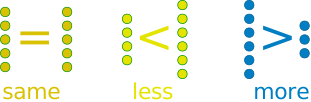
Like this:
| = |
When two values are equal, |
example: 2+2 = 4 |
| < |
When one value is smaller than another, |
example: 3 < 5 |
| > |
When one value is bigger than another, |
example: 9 > 6 |
Learn more about <, >, ≤ and ≥ here .
Less Than and Greater Than
< >
The "less than" sign and "greater than" sign look like a "V" on its side, don't they?
To remember which way around the "<" and ">" signs go, remember this:
- BIG > small
- small < BIG
The "small" end always points to the smaller number, like this:

Greater Than Symbol: BIG > small
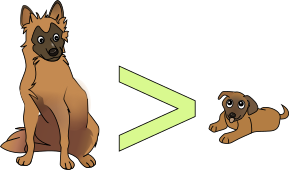
Example:
20 > 5
"20 is greater than 5"
Try It Yourself !
Practice comparing numbers with:
- Compare Numbers 0 to 10
- Compare Numbers 0 to 100
- Compare Numbers: -10 to +10 (introduces negative numbers)
- Compare Decimal Numbers: 0 to 1 (introduces decimal numbers)
- Compare Decimal Numbers: -1 to +1 (decimal numbers, and negatives too)
- Compare Unit Fractions (introduces simple fractions)
- Compare Fractions (more fractions)
4896, 4897, 4898, 4899, 4900, 4901, 4902, 4903, 4904, 4905