Fractions in Algebra
We can add, subtract, multiply and divide fractions in algebra in the same way we do in simple arithmetic.
Adding Fractions
To add fractions there is a simple rule:
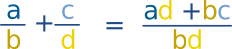
(See why this works on the Common Denominator page).
Example:
x 2 + y 5 = (x)(5) + (2)(y) (2)(5)
= 5x+2y 10
Example:
x + 4 3 + x − 3 4 = (x+4)(4) + (3)(x−3) (3)(4)
= 4x+16 + 3x−9 12
= 7x+7 12
Subtracting Fractions
Subtracting fractions is very similar, except that the + is now −
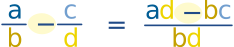
Example:
x + 2 x − x x − 2 = (x+2)(x−2) − (x)(x) x(x−2)
= (x2 − 22) − x2 x2 − 2x
= −4 x2 − 2x
Multiplying Fractions
Multiplying fractions is the easiest one of all: multiply the tops together, and the bottoms together:

Example:
3x x−2 × x 3 = (3x)(x) 3(x−2)
= 3x2 3(x−2)
= x2 x−2
Dividing Fractions
To divide fractions first "flip" the fraction we want to divide by, then use the same method as for multiplying:

Example:
3y2 x+1 ÷ y 2 = 3y2 x+1 × 2 y
= (3y2)(2) (x+1)(y)
= 6y2 (x+1)(y)
= 6y x+1
Hard: