Theorems, Corollaries, Lemmas
What are all those things? They sound so impressive!
Well, they are basically just facts: some result that has been arrived at.
- A Theorem is a major result
- A Corollary is a theorem that follows on from another theorem
- A Lemma is a small result (less important than a theorem)
Examples
Here is an example from Geometry:
Example: A Theorem and a Corollary
Theorem:
Angles on one side of a straight line always add to 180°.
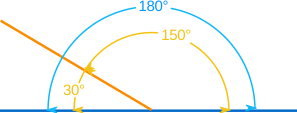
Corollary:
Following on from that theorem we find that where two lines intersect, the angles opposite each other (called Vertical Angles) are equal (a=c and b=d in the diagram).
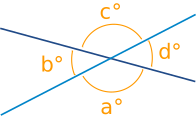
Angle a = angle c
Angle b = angle d
Proof:
Angles a and b add to 180° because they are along a line:
a + b = 180°
a = 180° − b
Likewise for angles b and c
b + c = 180°
c = 180° − b
And since both a and c equal 180° − b, then
a = c
And a slightly more complicated example from Geometry:
Example: A Theorem, a Corollary to it, and also a Lemma!
Theorem:
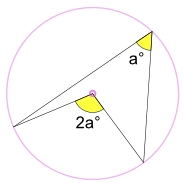
An inscribed angle a° is half of the central angle 2a°
Called the Angle at the Center Theorem.
Proof: Join the center O to A.
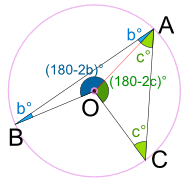
Triangle ABO is isosceles (two equal sides, two equal angles), so:
And, using Angles of a Triangle add to 180°:
Triangle ACO is isosceles, so:
And, using Angles of a Triangle add to 180°:
And, using Angles around a point add to 360°:
Replace b + c with a, we get:
Angle BAC = a° and Angle BOC = 2a°
And we have proved the theorem.
(That was a "major" result, so is a Theorem.)
Corollary
(This is called the "Angles Subtended by the Same Arc Theorem", but it’s really just a Corollary of the "Angle at the Center Theorem")
Keeping the endpoints fixed ... ... the angle a° is always the same, no matter where it is on the circumference:
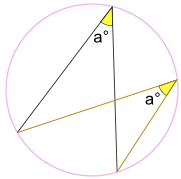
So, Angles Subtended by the Same Arc are equal.
Lemma
(This is sometimes called the "Angle in the Semicircle Theorem", but it’s really just a Lemma to the "Angle at the Center Theorem")
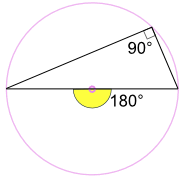
In the special case where the central angle forms a diameter of the circle:
2a° = 180° , so a° = 90°
So an angle inscribed in a semicircle is always a right angle.
(That was a "small" result, so it is a Lemma.)
Another example, related to Pythagoras' Theorem:
Example:
Theorem
If m and n are any two whole numbers and
- a = m2 − n2
- b = 2mn
- c = m2 + n2
then a2 + b2 = c2
Proof:
(That was a "major" result.)
Corollary
a, b and c, as defined above, are a Pythagorean Triple
Proof:
From the Theorem a2 + b2 = c2,
so a, b and c are a Pythagorean Triple
(That result "followed on" from the previous Theorem.)
Lemma
If m = 2 and n = 1, then we get the Pythagorean triple 3, 4 and 5
Proof:
If m = 2 and n = 1, then
- a = 22 − 12 = 4 − 1 = 3
- b = 2 × 2 × 1 = 4
- c = 22 + 12 = 4 + 1 = 5
(That was a "small" result.)