Divisibility Rules
Easily test if one number can be exactly divided by another
Divisible By
"Divisible By" means "when you divide one number by another the result is a whole number"
Examples:
14 is divisible by 7, because 14 ÷ 7 = 2 exactly
15 is not divisible by 7, because 15 ÷ 7 = 2 17 (the result is not a whole number)
0 is divisible by 7, because 0 ÷ 7 = 0 exactly (0 is a whole number)

"Divisible by" and "can be exactly divided by" mean the same thing
The Divisibility Rules
These rules let you test if one number is divisible by another, without having to do too much calculation!
Example: is 723 divisible by 3?
We could try dividing 723 by 3
Or use the "3" rule: 7+2+3=12, and 12 ÷ 3 = 4 exactly Yes
Note: Zero is divisible by any number (except by itself), so gets a "yes" to all these tests.
Any integer (not a fraction) is divisible by 1
The last digit is even (0, 2, 4, 6, 8)
128 Yes
129 No
The sum of the digits is divisible by 3
381 (3+8+1=12, and 12÷3 = 4) Yes
217 (2+1+7=10, and 10÷3 = 313) No
This rule can be repeated when needed:
99996 (9+9+9+9+6 = 42, then 4+2=6) Yes
The last 2 digits are divisible by 4
1312 is (12÷4=3) Yes
7019 is not (19÷4=434) No
We can also subtract 20 as many times as we want before checking:
68: subtract 3 lots of 20 and we get 8 Yes
102: subtract 5 lots of 20 and we get 2 No
Another method is to halve the number twice and see if the result is still a whole number:
124/2 = 62, 62/2 = 31, and 31 is a whole number. Yes
30/2 = 15, 15/2 = 7.5 which is not a whole number. No
The last digit is 0 or 5
175 Yes
809 No
Is even and is divisible by 3 (it passes both the 2 rule and 3 rule above)
114 (it is even, and 1+1+4=6 and 6÷3 = 2) Yes
308 (it is even, but 3+0+8=11 and 11÷3 = 3 23) No
Double the last digit and subtract it from a number made by the other digits. The result must be divisible by 7. (We can apply this rule to that answer again)
672 (Double 2 is 4, 67−4=63, and 63÷7=9) Yes
105 (Double 5 is 10, 10−10=0, and 0 is divisible by 7) Yes
905 (Double 5 is 10, 90−10=80, and 80÷7=11 37) No
The last three digits are divisible by 8
109816 (816÷8=102) Yes
216302 (302÷8=37 34) No
A quick check is to halve three times and the result is still a whole number:
816/2 = 408, 408/2 = 204, 204/2 = 102 Yes
302/2 = 151, 151/2 = 75.5 No
The sum of the digits is divisible by 9
(Note: This rule can be repeated when needed)
1629 (1+6+2+9=18, and again, 1+8=9) Yes
2013 (2+0+1+3=6) No
The number ends in 0
220 Yes
221 No
Add and subtract digits in an alternating pattern (add digit, subtract next digit, add next digit, and so on). Then check if that answer is divisible by 11.
1364 (+1−3+6−4 = 0) Yes
913 (+9−1+3 = 11) Yes
3729 (+3−7+2−9 = −11) Yes
987 (+9−8+7 = 8) No
The number is divisible by both 3 and 4 (it passes both the 3 rule and 4 rule above)
648
(By 3? 6+4+8=18 and 18÷3=6 Yes)
(By 4? 48÷4=12 Yes)
Both pass, so Yes
524
(By 3? 5+2+4=11, 11÷3= 3 23 No)
(Don't need to check by 4) No
There are lots more! Not only are there divisibility tests for larger numbers, but there are more tests for the numbers we have shown.
Factors Can Be Useful
Factors are the numbers you multiply to get another number:
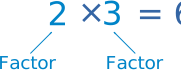
This can be useful, because:
When a number is divisible by another number ...
... then it is also divisible by each of the factors of that number.
Example: If a number is divisible by 6, it is also divisible by 2 and 3
Example: If a number is divisible by 12, it is also divisible by 2, 3, 4 and 6
Another Rule For 11
- Subtract the last digit from a number made by the other digits
- If that number is divisible by 11 then the original number is, too
Can repeat this if needed,
Example: 286
28 − 6 is 22, which is divisible by 11, so 286 is divisible by 11
Example: 14641
- 1464 − 1 is 1463
- 146 − 3 is 143
- 14 − 3 is 11, which is divisible by 11, so 14641 is divisible by 11