Parallel Lines, and Pairs of Angles
Parallel Lines
Lines are parallel if they are always the same distance apart (called "equidistant"), and never meet. Just remember:
Always the same distance apart and never touching.
The red line is parallel to the blue line in each of these examples:

Example 1

Example 2
Parallel lines also point in the same direction.
Parallel lines have so much in common. It's a shame they will never meet!
Try it yourself:
Pairs of Angles
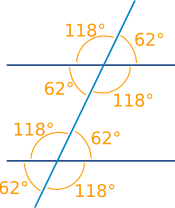
When parallel lines are crossed by another line (called a Transversal), special angle relationships appear.
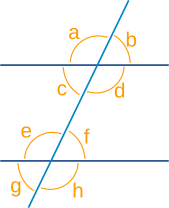
In this example, many angles are equal and form pairs of angles with unique names.
Click on each name below to see it highlighted:
Now play with it here. Try dragging the points, and choosing different angle types. You can also turn "Parallel" off or on:
If we know just one angle in the parallel line diagram, can we figure out all the other angles?
Testing for Parallel Lines
Some of these special angle pairs can be used to test if lines really are parallel:
|
|||||||||||||||||||||
Examples
| These lines are parallel, because a pair of Corresponding Angles are equal. | 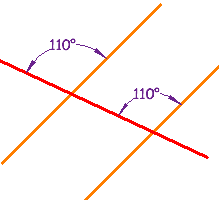 |
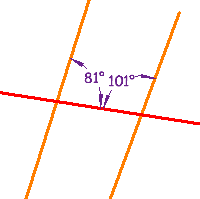 |
These lines are not parallel, because a pair of Consecutive Interior Angles don't add up to 180° (81° + 101° =182°) |
| These lines are parallel, because a pair of Alternate Interior Angles are equal | 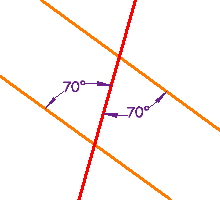 |