Slope (Gradient) of a Straight Line
The slope (also called Gradient) of a line tells us how steep it is.
To find the slope:
| Slope = Change in YChange in X | 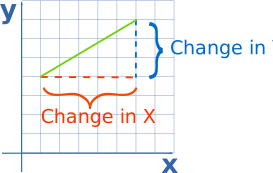 |
Have a play (drag the points):
Examples:
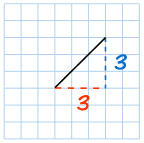 |
The slope of this line = 3 3 = 1 So the slope is equal to 1 In other words for every 3 steps right, the line goes up 3 steps. Since both are the same, the slope is 1. |
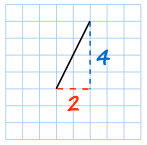 |
The slope of this line = 4 2 = 2 |
|
| The line is steeper, and so the slope is larger. | ||
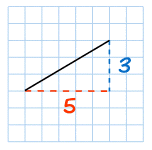 |
The slope of this line = 3 5 = 0.6 |
|
| The line is less steep, and so the slope is smaller. | ||
Positive or Negative?
Moving from left-to-right, the cyclist has to :
- Nosedive on a Negative slope
- Push up on a Positive slope

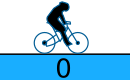

When measuring the line:
- Starting from the left and going across to the right is positive
(but going across to the left is negative). - Up is positive, and down is negative
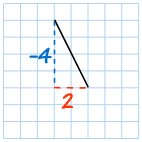 |
Slope = −4 2 = −2 |
That line goes down as you move along, so it has a negative slope.
Straight Across
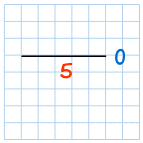 |
Slope = 0 5 = 0 |
A line that goes straight across (Horizontal) has a slope of zero.
Straight Up and Down
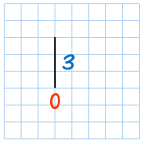 |
Slope = 3 0 = undefined |
That last one is a bit tricky ... you can't divide by zero,
so a "straight up and down" (vertical) line's slope is "undefined".
Rise and Run
We also call the horizontal change "run", and the vertical change "rise" or "fall":
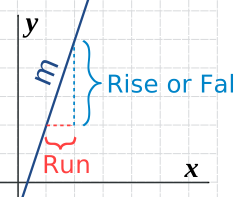
They are just different words, none of the calculations change.