Roman Numerals

Ancient Romans used a special method of showing numbers
Examples: They wrote C instead of 100
And wrote IX instead of 9
Read on to learn about Roman Numerals or go straight to the Roman Numeral Conversion Tool.
The Roman Symbols
Romans Numerals are based on the following symbols:
| 1 | 5 | 10 | 50 | 100 | 500 | 1000 |
|---|---|---|---|---|---|---|
|
I |
V |
X |
L |
C |
D |
M |
Basic Combinations
Which can be combined like this:
| 1 | 2 | 3 | 4 | 5 | 6 | 7 | 8 | 9 |
|---|---|---|---|---|---|---|---|---|
|
I |
II |
III |
IV |
V |
VI |
VII |
VIII |
IX |
| 10 | 20 | 30 | 40 | 50 | 60 | 70 | 80 | 90 |
|---|---|---|---|---|---|---|---|---|
|
X |
XX |
XXX |
XL |
L |
LX |
LXX |
LXXX |
XC |
| 100 | 200 | 300 | 400 | 500 | 600 | 700 | 800 | 900 |
|---|---|---|---|---|---|---|---|---|
|
C |
CC |
CCC |
CD |
D |
DC |
DCC |
DCCC |
CM |
Forming Numbers - The Rules
When a symbol appears after a larger (or equal) symbol it is added
- Example: VI = V + I = 5 + 1 = 6
- Example: LXX = L + X + X = 50 + 10 + 10 = 70
But if the symbol appears before a larger symbol it is subtracted
- Example: IV = V − I = 5 − 1 = 4
- Example: IX = X − I = 10 − 1 = 9
To Remember: After Larger is Added
Don't use the same symbol more than three times in a row (but IIII is sometimes used for 4, particularly on clocks)
How to Convert to Roman Numerals
Break the number into Thousands, Hundreds, Tens and Ones, and write down each in turn.
Example: Convert 1984 to Roman Numerals.
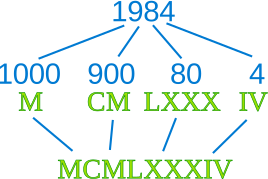
Break 1984 into 1000,900, 80 and 4, then do each conversion
- 1000 = M
- 900 = CM
- 80 = LXXX
- 4 = IV
1000 + 900 + 80 + 4 = 1984, so 1984 = MCMLXXXIV

How To Remember
Think "MeDiCaL XaVIer".
It has the roman numerals in descending order from 1000 to 1.
I, for one, like Roman numerals!
Really Big Numbers
Numbers greater than 1,000 are formed by placing a dash over the symbol, meaning "times 1,000", but these are not commonly used:
|
5,000 |
10,000 |
50,000 |
100,000 |
500,000 |
1,000,000 |
|---|---|---|---|---|---|
|
V |
X |
L |
C |
D |
M |
Conversion Tool
You can convert to/from Roman Numerals here: