Hyperbola
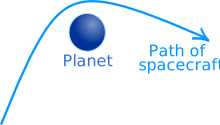
Did you know that the orbit of a spacecraft can sometimes be a hyperbola?
A spacecraft can use the gravity of a planet to alter its path and propel it at high speed away from the planet and back out into space using a technique called "gravitational slingshot".
If this happens, then the path of the spacecraft is a hyperbola.
(Play with this at Gravity Freeplay)
Definition
A hyperbola looks like two infinite bows, called "branches".
Looking at the left hand branch in this diagram:
any point P is closer to F than to G by some constant amount
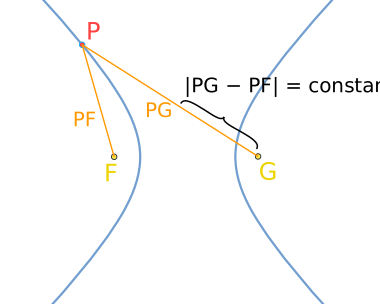
The other branch is a mirror image, where points are closer to G than to F by the same constant amount.
As a formula:
|PF − PG| = constant
- PF is the distance P to F
- PG is the distance P to G
- || is the absolute value function (makes any negative a positive)
F and G are each called a focus.
Have a try yourself:
Try moving point P: what do you notice about the lengths PF and PG ?
Also try putting point P on the other branch.
There are some other interesting things, too:
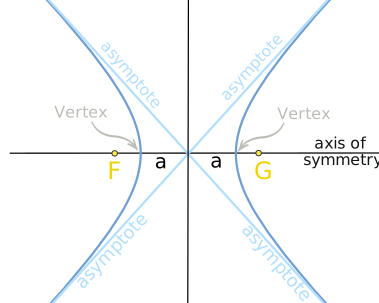
On the diagram you can see:
- two vertices (where each branch makes its sharpest turn)
- the transverse axis (the axis of symmetry that goes through each focus)
- the conjugate axis (the axis of symmetry that separates the two branches)
- two asymptotes which are not part of the hyperbola but show where the curve would go if continued indefinitely in each of the four directions
The distance between the vertices (2a on the diagram) is the same constant difference between the lengths PF and PG that we used to define the hyperbola
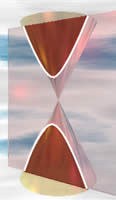
Conic SectionYou can also get a hyperbola when you slice through a double cone. The slice must be steeper than that for a parabola, but does not So the hyperbola is a conic section (a section of a cone). |
 |
Equation
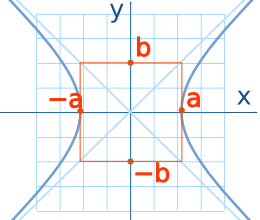
When we place the hyperbola with its center at the origin (0, 0) of an x-y graph and its branches open left and right along the x-axis, the equation of the curve is:
x2a2 − y2b2 = 1
Also:
One vertex is at (a, 0), and the other is at (−a, 0)
The asymptotes are the straight lines:
- y = (b/a)x
- y = −(b/a)x
(Note: the equation is similar to the equation of the ellipse: x2/a2 + y2/b2 = 1, except for a "−" instead of a "+")
Note: we can also use parametric equations, where we have another variable "t" and we calculate x and y from it, like this:
- x = a sec(t)
- y = b tan(t)
(Just imagine "t" going from 0° to 360°, what x and y values would we get?)
Up and Down
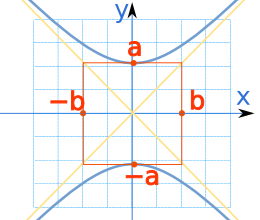
When the hyperbola opens up and down, the equation is:
y2a2 − x2b2 = 1
In this case, the vertices are at (0, a) and (0, −a).
Eccentricity
Any branch of a hyperbola can also be defined as a curve where the distances of any point from:
- a fixed point (the focus), and
- a fixed straight line (the directrix) are always in the same ratio
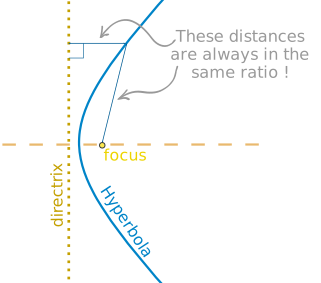
This ratio is called the eccentricity, and for a hyperbola it is always greater than 1.
The eccentricity (usually shown as the letter e) shows how "uncurvy" (varying from being a circle) the hyperbola is.
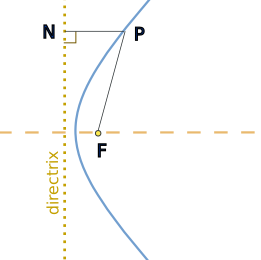
On this diagram:
- P is a point on the curve,
- F is the focus and
- N is the point on the directrix so that PN is perpendicular to the directrix
The eccentricity is the ratio PF/PN, and has the formula:
e = √(a2+b2)a
Using "a" and "b" from the diagram above.
Latus Rectum
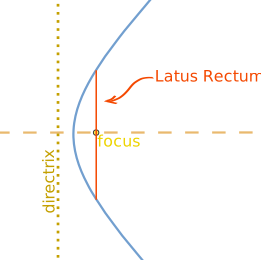 |
The Latus Rectum is the line through the focus and parallel to the directrix. The length of the Latus Rectum is 2b2/a. |
1/x
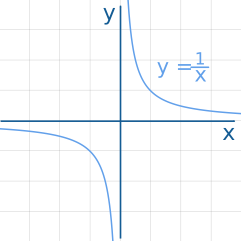
The reciprocal function y = 1/x is a hyperbola!