Verify Proportions
Proportion says two ratios (or fractions) are equal in value.
Example:

Both 13 and 26 are ratios
We see that 1-out-of-3 is equal to 2-out-of-6
The ratios are the same, so they are in proportion.
Learn more at Proportion. Here we focus on checking or verifying a proportion.
Proportions can be written in different ways. These are the same:
- 35 = 610
- 3 / 5 = 6 / 10
- 3 : 5 = 6 : 10
What Are Means and Extremes?
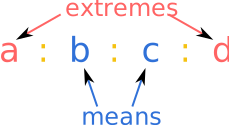
When a proportion is written like this:
a : b = c : d
- a and d are the extremes (the outside numbers)
- b and c are the means (the inside numbers)
Verifying a Proportion
To verify whether two ratios are proportional, we use this rule:
The product of the means equals the product of the extremes
This is cross multiplication. Here we use it to check the proportion.
Example: Verify this
3 / 5 = 6 / 10
Step 1: Identify means and extremes
- Means: 5 and 6
- Extremes: 3 and 10
Step 2: Multiply
Means: 5 × 6 = 30
Extremes: 3 × 10 = 30
They are equal! So the ratios are proportional.
Example 2: Verify this
4 : 7 = 6 : 10
Means: 7 × 6 = 42
Extremes: 4 × 10 = 40
The products are not equal, so the ratios are not proportional!
Checking Proportions Using Equivalent Fractions
Another way to check a proportion is to simplify each fraction.
Example
Check whether:
68 = 1520
Simplify both fractions:
68 ⇒ 34
1520 ⇒ 34
Since both fractions simplify to the same value, the ratios are proportional.
This method uses number sense and is often quicker when the numbers are small.
Solving vs Verifying a Proportion
It is important to know the difference:
- Verifying a proportion means checking whether two ratios are equal
- Solving a proportion means finding an unknown value
Ratio and Rate
A ratio compares two quantities.
A rate is a special kind of ratio that compares quantities with different units, such as distance and time.
- Ratio: 3 boys to 5 girls
- Rate: 60 kilometers per hour
Summary
- Equivalent ratios can be written as a proportion
- The outside numbers are the extremes
- The inside numbers are the means
- If the product of the means equals the product of the extremes, the ratios are proportional
- Proportions can also be checked by simplifying fractions