Power Rule for Integration
Derivatives
First let's look at the Power Rule for derivatives, one of the most commonly used rules in Calculus:
The derivative of xn is nx(n−1)
Example: What's the derivative of x2 ?
For x2 we use the Power Rule with n=2:
| The derivative of x2 | = | 2x(2−1) |
| = | 2x1 |
|
| = | 2x |
Answer: the derivative of x2 is 2x
Reverse the Rule
So for derivatives we have:
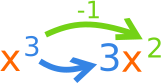
"multiply by power
then reduce power by 1"
And for integration we reverse the rule:
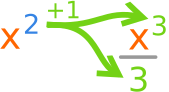
"add 1 to power
then divide by the new power"
Power Rule for Integration
The integral of xn is 1(n+1)x(n+1) + C
- But not for n = −1, as that leads to division by zero
- And C is the constant of integration. We add it because the derivative of any constant is zero, so there could have been a constant in the original function
Example: Finding the integral of x2:
| The integral of x2 | = | 1(2+1)x2+1 + C |
| = | 13x3 + C |
Answer: ∫ x2 dx = x3 3 + C
Example: What's ∫√x dx ?
√x is also x0.5
∫x0.5 dx = x1.51.5 + C
= 23x1.5 + C
How to Remember
"add 1 to power
then divide by the new power"
A Short Table
Here's the Power Rule for Integration with some sample values. See the pattern?
| f(x) | ∫ f(x) dx |
|---|---|
| 1 (or x0) | x + C |
| x | 12x2 + C |
| x2 | 13x3 + C |
| x3 | 14x4 + C |
| x4 | 15x5 + C |
| and so on... | |
| For negative exponents (except −1): | |
| x−2 | 1−1x−1 + C = −x−1 + C |
| x−3 | 1−2x−2 + C |
| and so on... | |
6824, 6825, 6834, 6835, 6827, 15373, 6833, 6839, 6840, 6842, 6843, 15367, 15375, 15376