Compound Events
An event can have more than one step, like flipping a coin and rolling a die. We call these compound events.
To find the probability of a compound event, we first need to figure out how many possible outcomes there are in total.
Listing Possible Outcomes
Example: Coin and Die
Let's say we flip a coin and roll a standard six-sided die:
- The coin can land on: Heads (H) or Tails (T)
- The die can land on: 1, 2, 3, 4, 5, 6
Now we pair every coin flip with every die roll:
- H1, H2, H3, H4, H5, H6
- T1, T2, T3, T4, T5, T6
Count them up ... there are exactly 12 possible outcomes in total.
Listing works beautifully when there are only a few choices, but what if we have lots of them?
The Basic Counting Principle
We can use a clever shortcut to find the number of outcomes using multiplication.
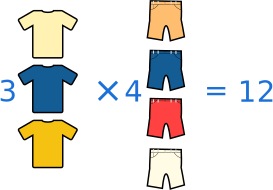
Example: Mixing and Matching Outfits
Let's try this: imagine we have 3 shirts and 4 pairs of pants in our closet. How many unique outfits can we make?
Instead of drawing every single combination, we just multiply! That means 3 × 4 = 12 different outfits.
OK, we could have counted those, but what about this?
Example: Ice Cream Shop Choices
Wow, look at the menu! We get to choose:
- 1 of 24 flavors
- 1 of 7 cones
So what does that mean for our total choices? Let's use our multiplication shortcut:
24 × 7 = 168
There are 168 different ice cream combinations we could order.
Finding Probabilities from Equal Outcomes
So how does counting outcomes help us find probabilities?
Well, if all the outcomes are equally likely to happen, we can use this simple relationship:
Probability = favorable outcomestotal outcomes
Example: Getting a Head and an Even Number
Let's go back to our coin-and-die example. Remember, we already found that there are 12 total outcomes.
What if we want to know the probability of getting a Head and an even number? Even numbers on a die are 2, 4, and 6.
Let's look at our list for our specific "favorable" outcomes:
- H2, H4, H6
That's 3 favorable outcomes out of the whole bunch.
Probability = 312 = 14
So, the probability is 1 out of 4, or 25%.
Another Compound Event
First, have a play with The Spinner.
Example: Two Spinners
Spinner A has 26 letters of the alphabet, and Spinner B has 10 digits.
We spin both, what's the probability of a letter A to F and an even digit?
To find the total possible outcomes, we multiply the spinner sections together:
26 × 10 = 260
Favorable outcomes are 6 letters A to F, and 5 even digits:
6 × 5 = 30
Which gives us:
Probability = 30260 = 326
Summary
- Compound events have more than one step
- We can list outcomes one by one, or count them quickly using multiplication
- The Basic Counting Principle is our shortcut to finding total outcomes
- If outcomes are equally likely, probability is the number of favorable outcomes ÷ total outcomes