Probability
How likely something is to happen.
Many events can't be predicted with total certainty. The best we can say is how likely they are to happen, using the idea of probability.
Tossing a Coin

When a coin is tossed, there are two possible outcomes:
Heads (H) or
Tails (T)
Also:
- the probability of the coin landing H is ½
- the probability of the coin landing T is ½
Throwing Dice
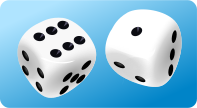
When a single die is thrown, there are six possible outcomes: 1, 2, 3, 4, 5, 6.
The probability of any one of them is 16
Probability
In general:
Probability of an event happening = Number of ways it can happenTotal number of outcomes
Example: the chances of rolling a "4" with a die
Number of ways it can happen: 1 (there's only 1 face with a "4" on it)
Total number of outcomes: 6 (there are 6 faces altogether)
So the probability = 16
Example: there are 5 marbles in a bag: 4 are blue, and 1 is red. What's the probability that a blue marble gets picked at random?
Number of ways it can happen: 4 (there are 4 blues)
Total number of outcomes: 5 (there are 5 marbles in total)
So the probability = 45 = 0.8
Probability Line
We can show probability on a Probability Line:
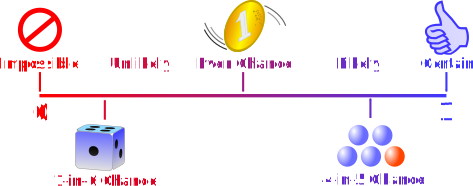
Probability is always between 0 and 1
Probability is Just a Guide
Probability doesn't tell us exactly what will happen, it is just a guide
Example: toss a coin 100 times, how many Heads will come up?
Probability says heads have a ½ chance, so we can expect 50 Heads.
But when we actually try it we might get 48 heads, or 55 heads ... or anything really, but in most cases it will be a number near 50.
Learn more at Probability Index.
Words
Some words have special meaning in Probability:
Experiment: a repeatable procedure with a set of possible results.
Example: Throwing dice
We can throw the dice again and again, so it is repeatable.
The set of possible results from any single throw is {1, 2, 3, 4, 5, 6}
Outcome: A possible result.
Example: "6" is one of the outcomes of a throw of a die.
Trial: A single performance of an experiment.
Example: I conducted a coin toss experiment. After 4 trials I got these results:
| Outcome | Trial 1 | Trial 2 | Trial 3 | Trial 4 |
|---|---|---|---|---|
| Head | ✔ | ✔ | ✔ | |
| Tail | ✔ |
Three trials had the outcome "Head", and one trial had the outcome "Tail"
Sample Space: all the possible outcomes of an experiment.
When we do an experiment once (one trial), we can list all the results that could happen. This list is called the sample space "S".
Make sure to include every possible outcome, and include each only once.
Example: Toss 1 coin once
We could get a Head or Tail:
Sample Space S = {H, T}
Example: Roll 1 die once
Sample Space S = {1, 2, 3, 4, 5, 6}
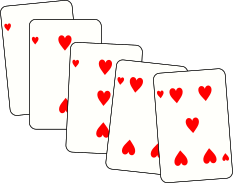
Example: Choosing a card from a deck
There are 52 cards in a deck (not including Jokers)
So the Sample Space is the set of all 52 possible cards:
Sample Space S = {Ace of Hearts, 2 of Hearts, and so on... }
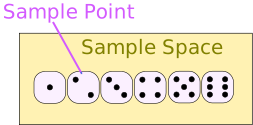
The Sample Space is made up of Sample Points:
Sample Point: just one of the possible outcomes
Example: Deck of Cards
- the 5 of Clubs is a sample point
- the King of Hearts is a sample point
"King" isn't a sample point. There are 4 Kings, so that's 4 different sample points.
Example: Throwing dice
There are 6 different sample points in that sample space.
Event: one or more outcomes of an experiment
Example Events:
An event can be just one outcome:
- Getting a Tail when tossing a coin
- Rolling a "5" with a die
An event can also include more than one outcome:
- Choosing a "King" from a deck of cards (any of the 4 Kings)
- Rolling an "even number" (2, 4 or 6)
Putting it all together
Hey, let's use those words, so you get used to them:
Example: Alex wants to see how many times a "double" comes up when throwing 2 dice.
The Sample Space is all possible Outcomes (36 Sample Points):
{1,1} {1,2} {1,3} {1,4} ...
...
... {6,3} {6,4} {6,5} {6,6}
The Event Alex is looking for is a "double", where both dice have the same number. It is made up of these 6 Sample Points:
{1,1} {2,2} {3,3} {4,4} {5,5} and {6,6}
These are Alex's Results:
| Trial | Is it a Double? |
|---|---|
| {3,4} | No |
| {5,1} | No |
| {2,2} | Yes |
| {6,3} | No |
| ... | ... |
After 100 Trials, Alex has 19 "double" Events ... is that close to what you would expect?

Do I get my treat now, or not?