Decimals
First, let's have an example:
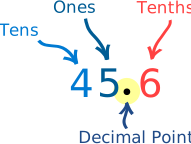
Here's the number "forty-five and six-tenths" written as a decimal number:
The decimal point goes between Ones and Tenths.
45.6 has 4 Tens, 5 Ones and 6 Tenths, like this:
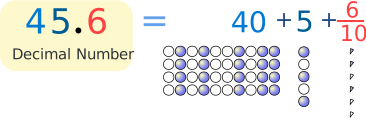
We can say it as "forty-five point six", or as "forty-five and six tenths" when we want to show the place value.
Now, let's discover how it all works ...
Place Value
It is all about Place Value !
When we write numbers, the position (or "place") of each digit
is important.
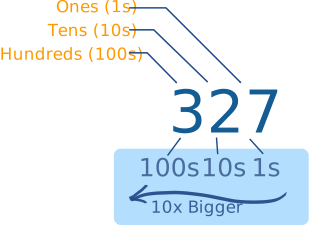
In the number 327:
- the "7" is in the Ones position, meaning 7 ones (which is 7),
- the "2" is in the Tens position meaning 2 tens (which is twenty),
- and the "3" is in the Hundreds position, meaning 3 hundreds
 |
| "Three Hundred Twenty Seven" |
 |
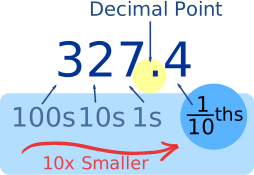
As we move left, each position is 10 times bigger! |
| Tens are 10 times bigger than Ones Hundreds are 10 times bigger than Tens |
... and ...
| As we move right, each position is 10 times smaller. |  |
| From Hundreds, to Tens, to Ones |
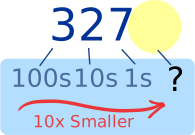 |
But what if we continue past Ones? What's 10 times smaller than Ones? 110ths (Tenths) are! |
| But we must first put a decimal point, so we know exactly where the Ones position is: |
 |
|
|
"three hundred twenty seven and four tenths" but we usually just say "three hundred twenty seven point four" |
||
And that is a Decimal Number!
Watch out for the 'th'!
- Tens are large (10, 20, ...)
- Tenths are small (1/10th, 2/10ths, ...)
That little 'th' at the end means it is a fraction of one.
Example: Real-world use of tenths and hundredths
We can use tenths and hundredths to measure things very precisely

For instance, a rope might be 2.75 meters long.
The 7 in the tenths place tells us there are seven tenths of a meter, and the 5 in the hundredths place tells us there are five hundredths of a meter.
In total, the rope is 2 meters and 75 hundredths of a meter long!

Money
Money is one of the most common ways we use decimals in everyday life.
- $1.00 means one whole dollar
- $0.10 means ten cents (one tenth of a dollar)
- $0.01 means one cent (one hundredth of a dollar)
Example
The amount $2.75 means:
- 2 whole dollars
- 7 tenths of a dollar (70¢)
- 5 hundredths of a dollar (5¢)
See Money and Decimals for more examples and activities.
Smaller
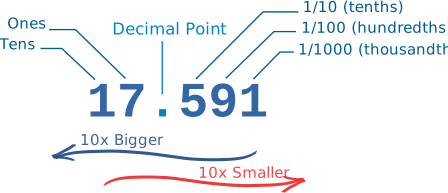
We can continue with smaller and smaller values, going from tenths and hundredths to thousandths and so on, like this:
Have a play with decimal numbers yourself:
Large and Small
So, our Decimal System lets us write numbers as large or as small as we want, using the decimal point. Digits can be placed left or right of a decimal point, to show values greater than one or less than one.
The decimal point is the most important part of a Decimal Number. Without it we are lost, and don't know what each position means.
| 17 |  |
591 | ||
| On the left of the decimal point is a whole number (such as 17). As we move further left, every place gets 10 times bigger. | |
|
||
|
|
The first digit on the right is tenths (1/10). As we move further right, every place gets 10 times smaller (one tenth as big). |
Zoom into decimals ...
App is at Zoomable Number Line.
Definition of Decimal
The word "Decimal" really means "based on 10" (From Latin decima: a tenth part).
We sometimes say "decimal" when we mean anything to do with our numbering system, but a "Decimal Number" usually means there's a Decimal Point.
Ways to think about Decimal Numbers ...
... as a Whole Number Plus Tenths, Hundredths, and so on
We can think of a decimal number as a whole number plus tenths, hundredths, and so on:
Example 1: What's 2.3 ?
- On the left side is "2", that's the whole number part
- The 3 is in the "tenths" position, meaning "3 tenths", or 3/10
- So, 2.3 is "2 and 3 tenths"
Example 2: What's 13.76 ?
- On the left side is "13", that's the whole number part
- There are two digits on the right side, the 7 is in the "tenths" position, and the 6 is the "hundredths" position
- So, 13.76 is "13 and 7 tenths and 6 hundredths"
... as a Decimal Fraction
Or we can think of a decimal number as a Decimal Fraction.
A Decimal Fraction is a fraction where the denominator (the bottom number) is a number such as 10, 100, 1000, and so on (in other words a power of ten)
| So "2.3" looks like: | 2310 |
| And "13.76" looks like: | 1376100 |
... as a Whole Number and Decimal Fraction
Or we can think of a decimal number as a Whole Number plus a Decimal Fraction.
| So "2.3" looks like: | 2 and 310 |
| And "13.76" looks like: | 13 and 76100 |
Those are all good ways to think of decimal numbers.