Isometry
An isometry is a transformation that preserves distance.
This means the size and shape stay exactly the same, and is called a rigid transformation.
In fact the new shape is congruent to the original.

Think of it like moving a physical object around on a table
We can slide it, turn it, or flip it over, but we can't stretch or squash it.
The Four Isometries
In the plane, there are only four types of isometries:
And now ... with Functions!
We can use functions to describe each transformation, unlocking the massive power of algebra. Any point P gets mapped to a new point P':
We use a transformation rule (like T, R, or G) to mean "a rule that takes a point P at (x, y) and finds a new position P':
Examples
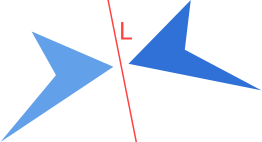
Reflection
across line L
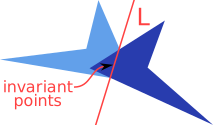
Also a Reflection
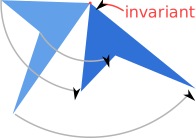
Rotation
(one point is invariant)
How to Identify an Isometry
We look for clues!
Orientation
Does the shape still face the same way?
Label the vertices in clockwise order A, B, C and so on:
- Direct (Preserved): A, B, C, ... stay clockwise. (Translation, Rotation)
- Opposite (Reversed): A, B, C, ... become counter-clockwise. (Reflection, Glide Reflection)
2. Invariant Points
Are there invariant points (that stay fixed).
- Translation: No invariant points (unless the slide is zero)
- Rotation: Exactly one invariant point (the center of rotation)
- Reflection: An entire line of invariant points (the axis)
- Glide Reflection: No invariant points
3. Parallel
Does a line segment stay parallel to its original version?
- Translation: Every line stays parallel to its original
- Rotation: No lines stay parallel (except for one or more 180° turns)
- Reflection/Glide: Generally no, except for lines parallel or perpendicular to the axis
Example

The orientation is reversed and there are no invariant points (all points are in different locations), so we are looking at a Glide Reflection.
In Summary:
| Transformation | Orientation | Invariant Points |
|---|---|---|
| Translation | Preserved | None |
| Rotation | Preserved | One point (center) |
| Reflection | Reversed | A whole line |
| Glide Reflection | Reversed | None |
Justifying an Isometry
To justify that a transformation is an isometry, we must prove that the distance between any two points A and B stays the same.
So for any two points A and B we have the same distance before as after: