Tessellation
A pattern of shapes that fit perfectly together!
A Tessellation (or Tiling) is when we cover a surface with a pattern of flat shapes so that there are no overlaps or gaps.
Examples:
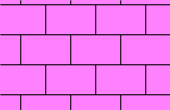
Rectangles
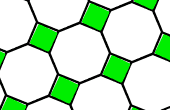
Octagons and Squares
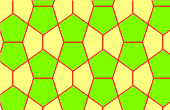
Different Pentagons
Regular Tessellations
A regular tessellation is a pattern made by repeating a regular polygon (which has all sides equal and angles equal).
There are only 3 regular tessellations:
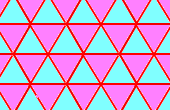
Triangles
3.3.3.3.3.3
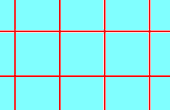
Squares
4.4.4.4
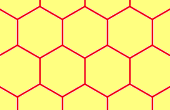
Hexagons
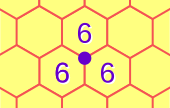
6.6.6
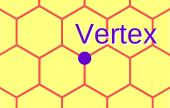
Look at a Vertex ...
|
||
|
Why Only 3 Regular Tessellations?
For shapes to fit perfectly at a vertex their angles must add up to exactly 360°.
Let's test the first few:
| Polygon | Interior Angle | How to get 360° | Fits? |
|---|---|---|---|
| Triangle | 60° | 60° × 6 = 360° | YES |
| Square | 90° | 90° × 4 = 360° | YES |
| Pentagon | 108° | 108° × 3.33... | NO (Gap) |
| Hexagon | 120° | 120° × 3 = 360° | YES |
| Heptagon | ~128.6° | 128.6° × 2.8... | NO (Overlap) |
| Octagon | 135° | 135° × 2.6... | NO (Overlap) |
Any shape with more than 6 sides has angles too large to fit 3 or more around a point without overlapping!
Semi-Regular Tessellations
A semi-regular tessellation is made of two or more regular polygons. The pattern at each vertex must be the same!
There are only 8 semi-regular tessellations:
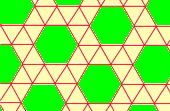
3.3.3.3.6
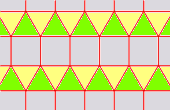
3.3.3.4.4
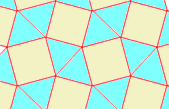
3.3.4.3.4
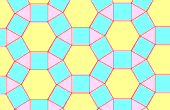
3.4.6.4
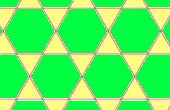
3.6.3.6
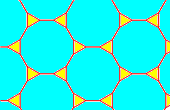
3.12.12
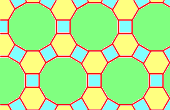
4.6.12
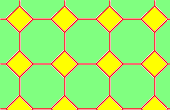
4.8.8
Naming
To name a tessellation, go around a vertex and write down how many sides each polygon has, in order, like "3.12.12".
And always start at the polygon with the least number of sides, so "3.12.12", not "12.3.12"
 |
Question 1: For all the tessellations above, is the pattern the same at each vertex? |
|
Question 2: One of those patterns becomes different when we make a mirror-image of it ... which one? |
Other Tessellations
There are also "demiregular" tessellations, but mathematicians disagree on what they actually are!
And some people allow curved shapes (not just polygons) so we can have tessellations like these:
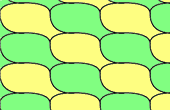
Curvy Shapes
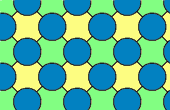
Circles
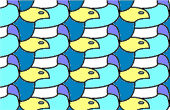
Eagles?
Tessellation Artist
All these images were made using Tessellation Artist, with some color added using a paint program.
You can try it too - maybe you will invent a new tessellation!

World Tessellation Day
World Tessellation Day is June 17. Celebrate!