Triangular Pyramid
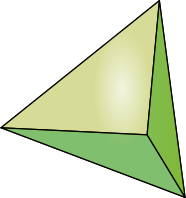
Jump to Surface Area or Volume
Imagine a pyramid made entirely of triangles, including its base (instead of the more familiar square base).
It's one of the simplest and most elegant 3D shapes.
Triangular Pyramid Facts
Notice these interesting things:
- It has 4 faces
- The 3 side faces are triangles
- The base is also a triangle
- It has 4 vertices (corner points)
- It has 6 edges
- It is also a tetrahedron
images/polyhedra.js?mode=tetrahedron
Surface Area
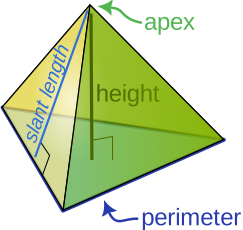
The surface area is the total area of all its faces. When the three side faces are the same we can use this shortcut formula:
Surface Area = [Base Area] + 12 × Perimeter × [Slant Length]
Example: Base Area is 28, Perimeter is 20, Slant length is 5
Surface Area = [Base Area] + 12 × Perimeter × [Slant Length]= 28 + 12 × 20 × 5= 28 + 50= 78
When side faces are different we can calculate the area of the base and each triangular face separately and then add them up.
Don't mix up Height and Slant Length:
- Slant Length goes along the sloping side face from the top peak to the bottom edge. We use this for Surface Area
- Height goes straight down from the top peak to the base (like dropping a plumb line). We use this for Volume
Volume
Volume = 13 × [Base Area] × Height
This works because a pyramid's volume is one-third that of a prism with the same base and height.
Example: base area is 28, height is 4.5
Volume= 13 × [Base Area] × Height= 13 × 28 × 4.5= 13 × 126= 42