How to Find the Mean
The mean is the average of the numbers.
It is easy to calculate: add up all the numbers, then divide by how many numbers there are.
In other words it is the sum divided by the count.
Example 1: What's the Mean of these numbers?
6, 11, 7
- Add the numbers: 6 + 11 + 7 = 24
- Divide by how many numbers (there are 3 numbers): 24 / 3 = 8
The Mean is 8
Why Does This Work?
It is because 6, 11 and 7 added together is the same as 3 lots of 8:
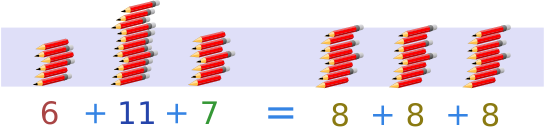
It is like you are "flattening out" the numbers
Example 2: Look at these numbers:
3, 7, 5, 13, 20, 23, 39, 23, 40, 23, 14, 12, 56, 23, 29
The sum of these numbers is 330
There are fifteen numbers.
The mean is equal to 330 / 15 = 22
The mean of the above numbers is 22
Negative Numbers
How do you handle negative numbers? Adding a negative number is the same as subtracting the number (without the negative). For example 3 + (−2) = 3−2 = 1.
Knowing this, let's try an example:
Example 3: Find the mean of these numbers:
3, −7, 5, 13, −2
- The sum of these numbers is 3 − 7 + 5 + 13 − 2 = 12
- There are 5 numbers
- The mean is equal to 12 ÷ 5 = 2.4
The mean of the above numbers is 2.4
Here it is in one line:
Mean = 3 − 7 + 5 + 13 − 25 = 125 = 2.4
Try it yourself!
Now have a look at The Mean Machine.
Advanced Topic: the mean we have just looked at is also called the Arithmetic Mean, because there are other means such as the Geometric Mean and Harmonic Mean.