Irrational Roots
We'll focus on square roots, but this applies broadly!
Square Root of 2
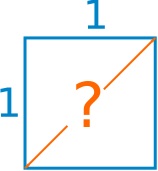
When we draw a square of size "1",
what's the distance across the diagonal?
The answer is the square root of 2, from the Pythagorean Theorem √12 + 12 = √2
Its value is 1.4142135623730950... and so on with no pattern to the decimals!
But it isn't a number like 3, or five-thirds, or anything like that ...
... in fact we can't write the square root of 2 using a ratio of two numbers ...
... and so it is an irrational number (meaning "no ratio", not nutty).
Read on to learn more.
Squares
To square a number, multiply it by itself.
Example: What's 3 squared?
| 3 Squared | = | 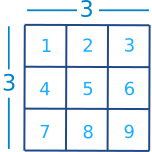 |
= 3 × 3 = 9 |
We call it squaring because it's exactly like finding the area of a square.
Square Roots
A square root goes the other way:
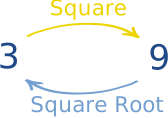
3 squared is 9, so a square root of 9 is 3
A square root of a number is ...
A square root of 9 is ...
Perfect Squares
Squaring a whole number gets a perfect square:
 |
||
| 1 | 1 | |
| 2 | 4 | |
| 3 | 9 | |
| 4 | 16 | |
| 5 | 25 | |
|
6 |
36 | |
|
... |
... | |
Generally
It also works generally.
Try the sliders below (note: '...' means the decimals continue on forever):
Use the sliders to answer these questions:
- What's the square root of 9?
- What's the square root of 10?
- What's the square root of 16?
Notice anything about their decimals?
Calculating Square Roots
It is easy to work out the square root of a perfect square, but it is really hard to work out other square roots.
Example: what's √10?
Well, 3 × 3 = 9 and 4 × 4 = 16, so we can guess the answer is between 3 and 4.
- Let's try 3.5: 3.5 × 3.5 = 12.25
- Let's try 3.2: 3.2 × 3.2 = 10.24
- Let's try 3.1: 3.1 × 3.1 = 9.61
- ...
Getting closer to 10, but it will take a long time to get a good answer!
|
At this point, I get out my calculator and it says: 3.1622776601683793319988935444327 But the digits just go on and on, without any pattern. If you tried to write it down exactly, you would be writing forever! Your pen would run out of ink, and you'd still have more digits to go. And the calculator's answer is only an approximation ! |
And it is an example of an Irrational Number.
Rational vs Irrational Numbers
Numbers can be rational (meaning they can be written as a ratio or fraction). Or they can be irrational (meaning "no ratio", not nutty).
How to tell the difference:
- Rational Numbers: Decimals that either stop (like 0.5) or repeat in a pattern (like 0.333... or 0.1428571428571...)
- Irrational Numbers: Decimals that go on forever without a pattern). π (Pi) is a famous irrational number, also e, the square root of 2 and many many more!
Estimating Roots (Between Whole Numbers)
When a number isn't a perfect square, its square root lies between two whole numbers.
You can estimate the square root by looking at the perfect squares on either side.
Example: What's √20?
1. Think of perfect squares near 20:
- 4 × 4 = 16
- 5 × 5 = 25
2. Since 20 is between 16 and 25, then √20 must be between 4 and 5.
Roots on a Number Line
Watch the decimals!
Beyond Squares of Whole Numbers
It isn't all about square roots and whole numbers.
Example: What's √(6.25) ?
Well ... 2.5 × 2.5 = 6.25, so:
√(6.25) = 2.5
A rational answer.
Example: What's 3√(1.331) ?
1.1 × 1.1 × 1.1 = 1.331, so:
3√(1.331) = 1.1
A rational answer.
We can make any number of such examples.
But moving a little bit sideways we most likely get irrational roots.
Example: What's 3√(1.332) ?
3√(1.332) = 1.1002754131311881304...
An irrational answer.
A Fun Way to Calculate a Square Root
There's a fun method for calculating a square root that gets more and more accurate each time around:
| a) start with a guess (let's guess 4 is the square root of 10) | |
 |
b) divide by the guess (10/4 = 2.5) c) add that to the guess (4 + 2.5 = 6.5) d) then divide that result by 2, in other words halve it. (6.5/2 = 3.25) e) now, set that as the new guess, and start at b) again |
- Our first attempt got us from 4 to 3.25
- Going again (b to e) gets us: 3.163
- Going again (b to e) gets us: 3.1623
And so, after 3 times around the answer is 3.1623, which is pretty good, because:
3.1623 × 3.1623 = 10.00014
Now ... why don't you try calculating the square root of 2 this way?