Introduction to Evolutionary Game Theory
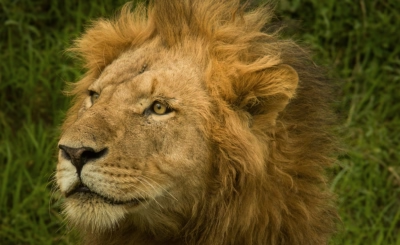
What happens when we mix biology with games? We get Evolutionary Game Theory! It helps us see how animals, and people, behave over long periods of time.
It explains two main ideas:
- How natural selection changes choices over time
- Why groups of animals share or fight
Scientists use this in biology. It is also useful in economics and AI. Let's look at a classic game to see how it works.
The Hawk-Dove Game
In this game, animals choose between two strategies:
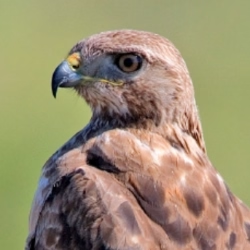
Hawk Strategy
(Fight and contest)
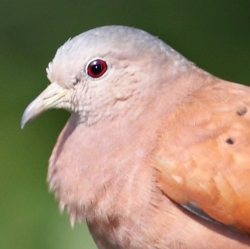
Dove Strategy
(Peaceful and share)
When two animals meet to get food, they pick a style. Here are the outcomes:
- Hawk meets Hawk: They fight. Both get hurt. They lose health. They get −2 points each
- Hawk meets Dove: The Hawk acts scary. The Dove runs away. The Hawk gets everything (+3 points). The Dove gets 0 points but stays safe
- Dove meets Dove: They share! Each gets a small reward of +1 point
Which style is best?
Think about it for a moment!
Hawks win big against Doves. But what if every animal chooses to be a Hawk? Then everyone fights. Everyone gets hurt and loses points!
We can map these scores in a table:
The best move depends on the mix of the crowd.
Example: Finding the Perfect Balance
Let's find the balance points using math.
- Let p be the share of Hawks
- Let 1 − p be the share of Doves
If you play as a Hawk:
- You meet a Hawk p of the time. You lose 2 points
- You meet a Dove 1 − p of the time. You gain 3 points
If you play as a Dove:
- You meet a Hawk p of the time. You get 0 points
- You meet a Dove 1 − p of the time. You gain 1 point
At the exact balance, both styles get the same score:
3 − 5p = 1 − p
3 − 1 = 5p − p
2 = 4p
p = 12
So, this group settles right at half Hawks and half Doves.
It Self-Corrects!
What if Hawks grow to 60% (p = 0.6)?
The Hawk score drops: 3 − 5(0.6) = 0.
The Dove score stays higher: 1 − 0.6 = 0.4.
Doves win more food! Their numbers grow. The count of Hawks goes right back down to 50%.
This is a stable equilibrium.
This steady state is called an Evolutionary Stable Strategy (ESS).
In nature, a Strategy is just a trait passed down by genes.
- It can be "always fight" (Hawk)
- It can be "always share" (Dove)
- It can be a mix of both

Evolution
Charles Darwin's ideas on evolution showed us that natural selection shapes not only how animals look, but also how they behave.
But there was still a puzzle: if life is purely a ruthless race to survive, why do animals ever share or cooperate?
More about ESS
An ESS is a plan that rules the group. If most animals use it, no new plan can beat it.
So nature finds a mix that keeps the whole group safe and stable.
If the group wanders away from this mix, natural selection drags it right back. It is like a self-fixing system!
Example: Helping Others in the Wild
Imagine a group of animals. They can be Selfish or Helpful.
- Two Selfish animals refuse to help. They get 2 points each
- A Helpful animal meets a Selfish one? The Helpful one gets 0. The Selfish one takes 6 points
- Two Helpful animals share and get 4 points each
Here's the table for this game:
Being selfish looks great at first. But the group usually ends up with a mix of both styles.
See Non-Zero-Sum Games.
This math shows exactly why wild animals support each other
Keep Exploring!
This is just the first step. There's a whole world of math hidden in how plants, animals, and germs interact.
Summary
Nature acts like a giant game. Animals don't choose plans by thinking. They "choose" them by surviving.
If an action helps an animal raise babies, that trait carries on to the next generation.