Common Number Sets
There are sets of numbers that are used so often they have special names and symbols:
| Symbol | Description | |
|---|---|---|
|
Natural Numbers The whole numbers from 1 upwards. (Or from 0 upwards in some fields of mathematics). Read More -> The set is {1,2,3,...} or {0,1,2,3,...} |
||
|
Integers The whole numbers {1,2,3,...}, negative whole numbers {..., -3,-2,-1} and zero {0}. So the set is {..., -3, -2, -1, 0, 1, 2, 3, ...} (Z is from the German "Zahlen" meaning numbers, because I is used for the set of imaginary numbers). Read More -> |
||
|
Rational Numbers The numbers you can make by dividing one integer by another (but not dividing by zero). In other words fractions. Read More -> Examples: 3/2 (=1.5), 8/4 (=2), 136/100 (=1.36), -1/1000 (=-0.001) Q is for "quotient" (because R is used for the set of real numbers): the result of dividing one number by another. It comes from the Italian "Quoziente". |
||
|
Irrational Numbers Any real number that's not a rational number. Read More -> |
||
|
Algebraic Numbers Any number that's a solution to a polynomial equation with rational coefficients. Includes all rational numbers, and some irrational numbers. Read More -> |
||
|
Transcendental Numbers Any number that's not an algebraic number Examples of transcendental numbers include π and e. Read More -> |
||
|
Real Numbers Any value on the number line: 
Also see Real Number Properties They are called "Real" numbers because they aren't Imaginary numbers. Read More -> |
||
|
Imaginary Numbers Numbers that when squared give a negative result. If you square a real number you always get a positive, or zero, result. For example 2×2=4, and (-2)×(-2)=4 also, so "imaginary" numbers can seem impossible, but they are still useful! Examples: √(-9) (=3i), 6i, -5.2i The "unit" imaginary number is √(-1) (the square root of minus one), and its symbol is i, or sometimes j. i2 = -1 |
||
|
Complex Numbers A combination of a real and an imaginary number in the form a + bi, where a and b are real, and i is imaginary. The values a and b can be zero, so the set of real numbers and the set of imaginary numbers are subsets of the set of complex numbers. Examples: 1 + i, 2 - 6i, -5.2i, 4 |
||

Illustration
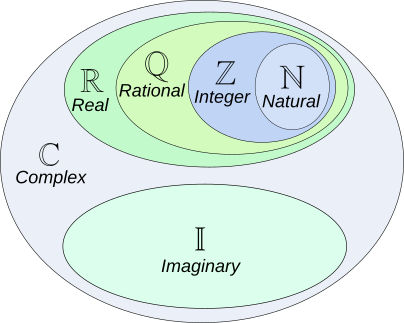
Natural numbers are a subset of integers
Integers are a subset of rational numbers
Rational numbers are a subset of real numbers
Combinations of real and imaginary numbers make up the complex numbers.
Number Sets In Action
Here are some algebraic equations, and the number set needed to solve them:
| Equation | Solution | Number Set | Symbol |
|---|---|---|---|
| x − 3 = 0 | x = 3 | Natural numbers | |
| x + 7 = 0 | x = −7 | Integers | |
| 4x − 1 = 0 | x = ¼ | Rational numbers | |
| x2 − 2 = 0 | x = ±√2 | Real numbers | |
| x2 + 1 = 0 | x = ±√(−1) | Complex numbers |
Other Sets
We can take an existing set symbol and place in the top right corner:
- a little + to mean positive, or
- a little * to mean non zero, like this:
And we can always use set-builder notation.