Tetrahedral Number Sequence
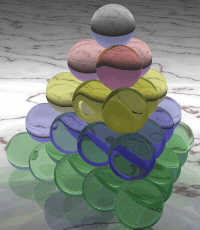
This is the Tetrahedral Number Sequence:
1, 4, 10, 20, 35, ...
We can understand it better when we think of a stack of marbles in the shape of a Tetrahedron.
Just count how many marbles are needed for a stack of a certain height.
- For height=1 we only need 1 marble
- For height=2, we need 4 marbles (1 at the top and 3 below)
- For height=3 we need 10 marbles
- For height=4 we need 20 marbles
- For height=5 we need 35 marbles
- How many for height=6 ... ?
The Formula
We can calculate the n-th tetrahedral number directly using this formula:
xn = n(n + 1)(n + 2)6
Let's try it for n = 4 (the 4th tetrahedral number):
It matches our table perfectly!
Triangular and Tetrahedral Numbers
Each layer in the tetrahedron of marbles is actually part of the Triangular Number Sequence (1, 3, 6, and so on). And both the triangular numbers and the tetrahedral numbers are on Pascal's Triangle.
This table shows the values for the first few layers:
| n (Height) |
Triangular Number (Marbles in Layer) |
Tetrahedral Number (Total Marbles) |
|---|---|---|
| 1 | 1 | 1 |
| 2 | 3 | 4 |
| 3 | 6 | 10 |
| 4 | 10 | 20 |
| 5 | 15 | 35 |
| 6 | 21 | 56 |
Examine the numbers and notice how each layer builds on the last:
Previous Total + New Layer (Triangular Number) = New Total (Tetrahedral Number)
For example:
- We have a stack of 4 (the 2nd tetrahedral number)
- We add a new bottom layer of 6 (the 3rd triangular number)
- We get a new total of 10 (the 3rd tetrahedral number): 4 + 6 = 10
- And so on