Activity: Currency Conversion

In this activity, you will learn how to convert money between different currencies using an exchange rate table and a calculator.
You will need
- a calculator (or use this calculator)
- A current list of exchange rates (look up on the internet)
Vacation!
The Martin family live in the US and are going to visit many different countries on their vacation.
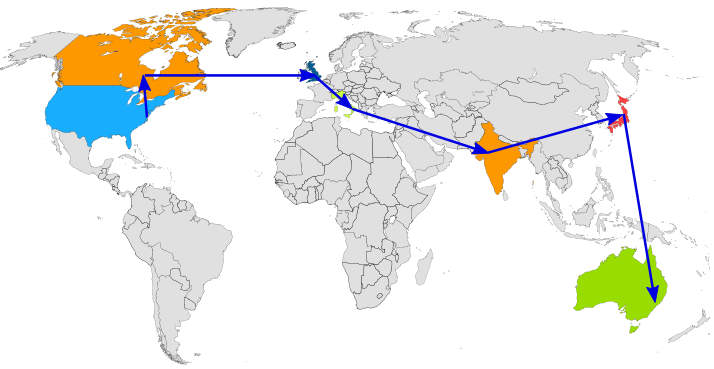
From their home in New York they travel to Toronto (Canada), London (England), Rome (Italy), New Delhi (India), Tokyo (Japan) and Sydney (Australia), before returning home across the Pacific.
The route is shown on the following map:
Mr. Martin uses his credit card to change money from USD ($US) to the local currency in each of the locations they visit.
Because currencies change all the time, the amount of money Mr. Martin receives in each local currency will change from day to day. But the following table (old data) will give you an idea of how currencies are converted:
| Currency | Code | Unit/USD | USD/Unit |
| Australian Dollar | AUD | 0.6716 | 1.4889 |
| Canadian Dollar | CAD | 0.7334 | 1.3634 |
| Euro | EUR | 1.0647 | 0.9392 |
| British Pound | GBP | 1.2202 | 0.8195 |
| Indian Rupee | INR | 0.01206 | 82.84 |
| Japanese Yen | JPY | 0.00728 | 137.31 |
You will often see them quoted like "AUD/USD 0.6716" meaning that 1 Australian Dollar will get you 0.6716 USD
Or "USD/JPY 137.31" meaning that 1 USD will get you 137.31 Japanases Yen.
So which figure should you use?
- The Unit/USD figure tells us how many USD we get for 1 of the other currency.
- The USD/Unit figure tells us how much of the other currency we get per 1 US Dollar
Your Turn
Find today's current exchange rates. Use the internet to find them and fill them in:
| Currency | Code | Unit/USD | USD/Unit |
| Australian Dollar | AUD | ||
| Canadian Dollar | CAD | ||
| Euro | EUR | ||
| British Pound | GBP | ||
| Indian Rupee | INR | ||
| Japanese Yen | JPY |
Let's look at an example
Mr. Martin converts USD500 to Canadian dollars. How much does he receive?
First find the "Canadian Dollar" row.
Then, because we are converting from the US currency to the Canadian currency, we should use the USD/Unit column:
| Currency | Code | Unit/USD | USD/Unit |
| Australian Dollar | AUD | 0.6716 | 1.4889 |
| Canadian Dollar | CAD | 0.7334 | 1.3634 |
| Euro | EUR | 1.0647 | 0.9392 |
| British Pound | GBP | 1.2202 | 0.8195 |
| Indian Rupee | INR | 0.01206 | 82.84 |
| Japanese Yen | JPY | 0.00728 | 137.31 |
So he receives USD500 × 1.3634 = CAD681.70
Your Turn
How much will Mr. Martin receive if he changes
- USD1000 to British pounds?
- USD650 to Euro?
- USD400 to Indian Rupees?
Another Example
When the Martin family arrives back in the US from Australia, Mr. Martin finds he has AUD220 left over and wants to change it back into USD. How much does he receive?
We use the "Australian Dollar" row, and because we are converting from the Australian currency to the US currency, we should use the Unit/USD column:
| Currency | Code | Unit/USD | USD/Unit |
| Australian Dollar | AUD | 0.6716 | 1.4889 |
| Canadian Dollar | CAD | 0.7334 | 1.3634 |
| Euro | EUR | 1.0647 | 0.9392 |
| British Pound | GBP | 1.2202 | 0.8195 |
| Indian Rupee | INR | 0.01206 | 82.84 |
| Japanese Yen | JPY | 0.00728 | 137.31 |
So he receives AUD220 × 0.6716 = USD147.75
Your Turn
Mr. Martin also has some other money left over. How much will he receive in USD for:
- 2,000 Yen?
- 3,500 Indian Rupees?
- 70 Euro?