Conjugate
The conjugate is where we change the sign in the middle of two terms like this:
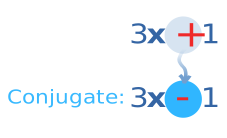
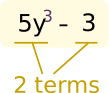 |
| example of a binomial |
Here are some more examples:
| Expression | Its Conjugate | |
|---|---|---|
| x2 − 3 | ⇔ | x2 + 3 |
| a + b | ⇔ | a − b |
| a − b3 | ⇔ | a + b3 |
Examples of Use
The conjugate can be very useful because ...
... when we multiply something by its conjugate we get squares like this:
How does that help?
It can help us move a square root from the bottom of a fraction (the denominator) to the top, or vice versa. Read Rationalizing the Denominator to discover more:
Example: Move the square root of 2 to the top:
We can multiply both top and bottom by 3+√2 (the conjugate of 3−√2), which won't change the value of the fraction:
13−√2 × 3+√23+√2 = 3+√232−(√2)2 = 3+√27
(The denominator becomes (a+b)(a−b) = a2 − b2 which simplifies to 9−2=7)
Use a calculator to work out the value before and after ... is it the same?
So try to remember this little trick, it may help you solve an equation one day!