Rationalize the Denominator
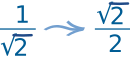
Oh No! An Irrational Denominator!
The bottom of a fraction is called the denominator.
Numbers like 2 and 3 are rational.
But many roots, such as √2 and √3, are irrational.
Example: 1 √2 has an Irrational Denominator

To be in "simplest form" the denominator should not be irrational!
Fixing it (by making the denominator rational)
is called "Rationalizing the Denominator"
Note: an irrational denominator is not wrong, it still works. But it is not "simplest form" and so can cost you marks.
Also equations can be easier to solve and calculations can be easier without an irrational denominator, so you should learn how.
So ... how?
1. Multiply Both Top and Bottom by a Root
Sometimes we can just multiply both top and bottom by a root:
Example: 1 √2 has an Irrational Denominator. Let's fix it.
Multiply top and bottom by the square root of 2, because: √2 × √2 = 2:
1 √2 × √2 √2 = √2 2
Now the denominator is a rational number (2). Done!
Having an irrational number in the top (numerator) of a fraction is preferred.
See below for a comparison between calculating 1 √2 and √2 2
2. Multiply Both Top and Bottom by the Conjugate
There is another special way to move a square root from the bottom of a fraction to the top ... we multiply both top and bottom by the conjugate of the denominator.
The conjugate is where we change the sign in the middle of two terms:
The method we will see works because when we multiply something by its conjugate we get squares like this:
(a+b)(a−b) = a2 − b2
Here's how we can do it:
Example: here is a fraction with an "irrational denominator":
How can we move the square root of 2 to the top?
We can multiply both top and bottom by 3+√2 (the conjugate of 3−√2), which won't change the value of the fraction:
1 3−√2 × 3+√2 3+√2 = 3+√2 32−(√2)2 = 3+√2 7
(Did you see that we used (a+b)(a−b) = a2 − b2 in the denominator?)
Use your calculator to work out the value before and after ... is it the same?
There is another example on the page Evaluating Limits (advanced topic) where I move a square root from the top to the bottom.
Useful
So try to remember these little tricks, it may help you solve an equation one day!
For fun let's try calculating both 1 √2 and √2 2
They should be the same. Let's use 1.414 as a rough estimate for √2
For 1 √2 ≈ 1 1.414 we need long division:
1.414 )1.000
0
1.0000
0.9898
0.0102
etc... give up, too hard!
The answer is 0.70... something.
Now let's try √2 2 ≈ 1.414 2:
1.414 2 = 0.707 easy!
Which form do you prefer?