Difference of Two Cubes
A special case when multiplying polynomials that produces a3 − b3
Polynomials
A polynomial looks like this:
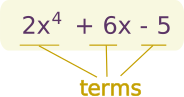
example of a polynomial
Difference of Two Cubes
The Difference of Two Cubes is a special case of multiplying polynomials that looks like this:
(a − b)(a2 + ab + b2) = a3 − b3
It comes up sometimes when doing solutions, so is worth remembering.
And this is why it works out (press play):
Example from Geometry:
Let's take the "x" cube and subtract the "y" cube!
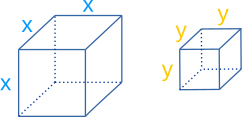
First, we split the "x" cube into four smaller boxes (cuboids), with box A being a cube of size "y":

The volumes of these boxes are:
- A = y3
- B = x2(x − y)
- C = xy(x − y)
- D = y2(x − y)
And together, A, B, C and D make up the "x" cube with volume x3:

Yes! It is the same formula as (a − b)(a2 + ab + b2) = a3 − b3
Thank goodness.
Sum of Two Cubes
There's also the "Sum of Two Cubes"
By changing the sign of b in each case we get:
(a + b)(a2 − ab + b2) = a3 + b3
Note the minus in front of "ab".
To Remember the Signs Use SOAP!
a3 − b3 = (a − b)(a2 + ab + b2)
a3 + b3 = (a + b)(a2 − ab + b2)
- S: The first sign is the Same as the original expression
- O: The second sign is the Opposite
- AP: The last sign is Always Positive
Example: Factor x3 − 8 using SOAP
a=x, and 8 is 23, so b=2: