Polynomials
A polynomial looks like this:
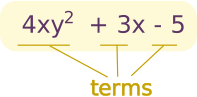 |
| example of a polynomial this one has 3 terms |
Polynomial comes from poly- (meaning "many") and -nomial (in this case meaning "term") ... so it says "many terms"
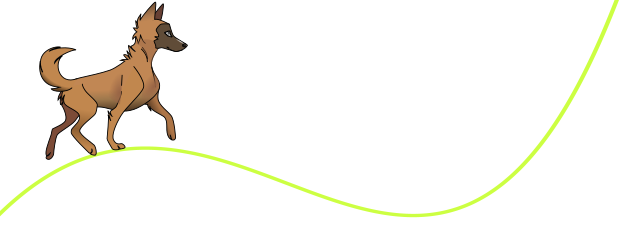
Polynomials with one variable make nice smooth curves:
A polynomial can have:
- constants (like 3, −20, or ½)
- variables (like x and y)
- exponents (like the 2 in y2), but only 0, 1, 2, 3, ... and so on are allowed
that can be combined using addition, subtraction, multiplication and division ...
... but not division by a variable (so something like 2/x is right out)
So:
A polynomial can have constants, variables and exponents,
but never division by a variable.
Also they can have one or more terms, but not an infinite number of terms.
Polynomial or Not?
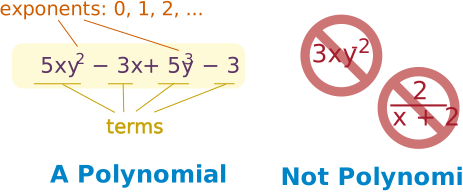
These are polynomials:
- 3x
- x − 2
- −6y2 − (79)x
- 3xyz + 3xy2z − 0.1xz − 200y + 0.5
- 512v5 + 99w5
- 5
(Yes, "5" is a polynomial, one term is allowed, and it can be just a constant!)
These are not polynomials
- 3xy-2 is not, because the exponent is "-2" (exponents can only be 0,1,2,...)
- 2/(x+2) is not, because dividing by a variable is not allowed
- 1/x is not either
- √x is not, because the exponent is "½" (see fractional exponents)
But these are allowed:
- x/2 is allowed, because we can divide by a constant
- also 3x/8 for the same reason
- √2 is allowed, because it is a constant (= 1.4142... and so on)
Monomial, Binomial, Trinomial
There are special names for polynomials with 1, 2 or 3 terms:

How do you remember the names? Think cycles!

There is also quadrinomial (4 terms) and quintinomial (5 terms),
but those names are not often used.
Variables
Polynomials can have no variable at all
Example: 21 is a polynomial. It has just one term, which is a constant.
Or one variable
Example: x4 − 2x2 + x has three terms, but only one variable (x)
Or two or more variables
Example: xy4 − 5x2z has two terms, and three variables (x, y and z)
What is Special About Polynomials?
Because of the strict definition, polynomials are easy to work with.
For example we know that:
- when we add polynomials we get a polynomial
- when we multiply polynomials we get a polynomial
So we can do lots of additions and multiplications, and still have a polynomial as the result.
Also, polynomials of one variable are easy to graph, as they have smooth and continuous lines.
Example: x4−2x2+x
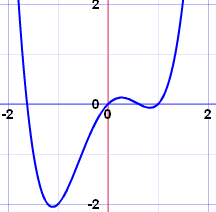 |
See how nice and |
We can also divide polynomials (but the result may not be a polynomial).
Degree
The degree of a polynomial with only one variable is the largest exponent of that variable.
Example:
Every term has a degree!
We can (but usually don't) write a polynomial like above with every degree shown, like this:
Because
- x1 is simply x
- x0 is simply 1, so 2x0 is 2 × 1 = 2
Learn more at Degree (of an Expression).
Standard Form
The Standard Form for writing a polynomial is to put the terms with the highest degree first.
Example: Put this in Standard Form: 3x2 − 7 + 4x3 + x6
The highest degree is 6, so that goes first, then 3, 2 and then the constant last:
x6 + 4x3 + 3x2 − 7
When a polynomial is written in Standard Form, the first term is called the leading term, and its number part is the leading coefficient.
In our example the leading term is x6, and its leading coefficient is 1 (because x6 really means 1x6).
You don't have to use Standard Form, but it helps.