Degree (of an Expression)
"Degree" can mean several things in mathematics:
- In Geometry a degree (°) is a way of measuring angles,
- But here we look at what degree means in Algebra.
In Algebra "Degree" is sometimes called "Order"
Degree of a Polynomial (with one variable)
A polynomial looks like this:
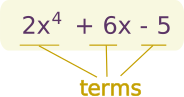 |
| example of a polynomial this one has 3 terms |
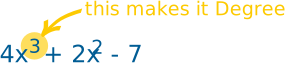
More Examples:
| 4x | The Degree is 1 (a variable without an exponent actually has an exponent of 1) |
|
| 4x3 − x + 3 | The Degree is 3 (largest exponent of x) | |
| x2 + 2x5 − x | The Degree is 5 (largest exponent of x) | |
| z2 − z + 3 | The Degree is 2 (largest exponent of z) |
Names of Degrees
When we know the degree we can also give it a name!
| Degree | Name | Example |
|---|---|---|
| 0 | Constant | 7 |
| 1 | Linear | x+3 |
| 2 | Quadratic | x2−x+2 |
| 3 | Cubic | x3−x2+5 |
| 4 | Quartic | 6x4−x3+x−2 |
| 5 | Quintic | x5−3x3+x2+8 |
Example: y = 2x + 7 has a degree of 1, so it is a linear equation
Example: 5w2 − 3 has a degree of 2, so it is quadratic
Higher order equations are usually harder to solve:
- Linear equations are easy to solve
- Quadratic equations are a little harder to solve
- Cubic equations are harder again, but there are formulas to help
- Quartic equations can also be solved, but the formulas are very complicated
- Quintic equations have no formulas, and can sometimes be unsolvable!
Degree of a Polynomial with More Than One Variable
When a polynomial has more than one variable, we need to look at each term. Terms are separated by + or - signs:
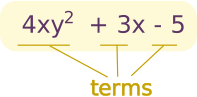 |
| example of a polynomial with more than one variable |
For each term:
- Find the degree by adding the exponents of each variable in it,
The largest such degree is the degree of the polynomial.
Example: what is the degree of this polynomial:
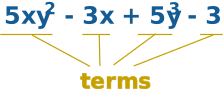
Checking each term:
- 5xy2 has a degree of 3 (x has an exponent of 1, y has 2, and 1+2=3)
- 3x has a degree of 1 (x has an exponent of 1)
- 5y3 has a degree of 3 (y has an exponent of 3)
- 3 has a degree of 0 (no variable)
The largest degree of those is 3 (in fact two terms have a degree of 3), so the polynomial has a degree of 3
Example: what is the degree of this polynomial:
4z3 + 5y2z2 + 2yz
Checking each term:
- 4z3 has a degree of 3 (z has an exponent of 3)
- 5y2z2 has a degree of 4 (y has an exponent of 2, z has 2, and 2+2=4)
- 2yz has a degree of 2 (y has an exponent of 1, z has 1, and 1+1=2)
The largest degree of those is 4, so the polynomial has a degree of 4
Writing it Down
Instead of saying "the degree of (whatever) is 3" we write it like this:
When Expression is a Fraction
We can work out the degree of a rational expression (one that is in the form of a fraction) by taking the degree of the top (numerator) and subtracting the degree of the bottom (denominator).
Here are three examples:
Calculating Other Types of Expressions
Warning: Advanced Ideas Ahead!
We can sometimes work out the degree of an expression by dividing ...
- the logarithm of the function by
- the logarithm of the variable
... then do that for larger and larger values, to see where the answer is "heading".
But making a table of values shows what is happening nicely, like this example:
Example: The degree of 3 + √x
Let us try increasing values of x:
| x | ln(3 + √x) | ln(x) | ln(3 + √x)ln(x) |
|---|---|---|---|
| 2 | 1.48483 | 0.69315 | 2.1422 |
| 4 | 1.60944 | 1.38629 | 1.1610 |
| 10 | 1.81845 | 2.30259 | 0.7897 |
| 100 | 2.56495 | 4.60517 | 0.5570 |
| 1,000 | 3.54451 | 6.90776 | 0.5131 |
| 10,000 | 4.63473 | 9.21034 | 0.5032 |
| 100,000 | 5.76590 | 11.51293 | 0.5008 |
| 1,000,000 | 6.91075 | 13.81551 | 0.5002 |
Looking at the table:
- as x gets larger then ln(3 + √x)ln(x) gets closer and closer to 0.5
So the Degree is 0.5 (in other words 1/2)
(Note: this agrees nicely with x½ = square root of x, see Fractional Exponents)
Some Degree Values
| Expression | Degree |
|---|---|
| log(x) | 0 |
| ex | ∞ |
| 1/x | −1 |
| √x | 1/2 |