Using Rational Expressions
A Rational Expression is the ratio of two polynomials:
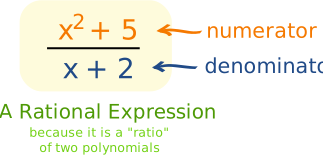
Using Rational Expressions
Using Rational Expressions is very similar to Using Rational Numbers (you may like to read that first).
Adding Rational Expressions
When the denominators (bottom parts) are the same, we just add the numerators (top parts):
Example: Same Denominators
2xx+3 + 5x+3 = 2x + 5x+3
But when the denominators are different, the easiest way is to use the common denominator method (similar to adding fractions):

And then simplify the result.
Example:
2x−2 + 3x+1 = 2 × (x+1) + (x−2) × 3(x−2) × (x+1)
(Comparing to the formula above: a is 2, b is x−2, c is 3, and d is x+1)
Then we simplify it:
= 2(x+1) + 3(x−2)(x−2)(x+1)
= 2x+2 + 3x−6x2 + x − 2x − 2
= 5x−4x2 − x − 2
Subtracting Rational Expressions
Subtracting is similar to adding, but be careful to subtract:

Example:
2x−2 − 3x+1 = 2 × (x+1) − 3 × (x−2)(x−2) × (x+1)
Watch that minus sign!
And then simplify:
= 2x+2 − (3x−6)x2 + x − 2x − 2
= −x + 8x2 − x − 2
When subtracting, the negative sign applies to the entire numerator of the second part. We use parentheses to make sure we distribute it correctly:
2x + 2 − (3x − 6) = 2x + 2 − 3x + 6 = −x + 8
Multiplication
To multiply two Rational Expressions, just multiply the tops and bottoms separately, like this:
Example:
2x−2 × 3x+1 = 2×3(x−2)(x+1)
And then simplify:
= 6x2−x−2
Division
To divide two Rational Expressions, first flip the second expression over (make it a reciprocal) and then do a multiply like above:
Example:
First flip the second one over and make it a multiply:
2x−2 ÷ 3x+1 = 2x−2 × x+13
Then do the multiply:
2x−2 × x+13 = 2(x+1)3(x−2)
Simplifying
We should find any values that make the denominator zero, as these aren't in the domain of the expression. Excluding these ensures the expression remains defined.
Example:
x2 − 1x + 1 is undefined when x = −1
Its Domain (the values that can go into the expression) doesn't include −1
Now, we can factor x2−1 into (x−1)(x+1) so we get:
(x−1)(x+1)(x+1)
It is now tempting to cancel (x+1) from top and bottom, giving:
x − 1
But this creates a different function, because its Domain now does include −1.
The original expression was never defined at x = −1, so that value must still be excluded.
So the simplified form x − 1 is equivalent to the original expression on its Domain, but the graph has a hole at x = −1.