Basic Math Definitions
We have collected some basic definitions on this page.
For more definitions, explanations, etc, use search above.
Or look up your word in the Illustrated Mathematics Dictionary:
The Basic Operations
In basic mathematics there are many ways of saying the same thing:
|
Symbol |
Words Used |
|---|---|
| + | Addition, Add, Sum, Plus, Increase, Total |
| − | Subtraction, Subtract, Minus, Less, Difference, Decrease, Take Away, Deduct |
| × | Multiplication, Multiply, Product, By, Times, Lots Of |
| ÷ | Division, Divide, Quotient, Goes Into, How Many Times |
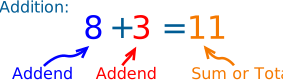
Addition is ...
... bringing two or more numbers (or things) together to make a new total.
The numbers to be added together are called the "Addends":
Subtraction is ...
... taking one number away from another.
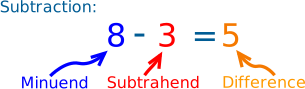
Minuend − Subtrahend = Difference
Minuend:The number that is to be subtracted from.
Subtrahend:The number that is to be subtracted.
Difference: The result of subtracting one number from another.
Multiplication is ...
... (in its simplest form) repeated addition.
Here we see that 6+6+6 (three 6s) make 18:
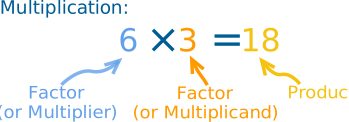
It can also be said that 3+3+3+3+3+3 (six 3s) make 18
But we can also multiply by fractions or decimals, which goes beyond the simple idea of repeated addition:
Example: 3.5 × 5 = 17.5
which is 3.5 lots of 5, or 5 lots of 3.5
Division is ...
... splitting into equal parts or groups. It is the result of "fair sharing".
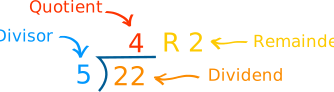
Division has its own special words to remember.
Let's take the simple question of 22 divided by 5. The answer is 4, with 2 left over.
Here we see the important words:

Which can also be in this form:
A Fraction is ...
... part of a whole.
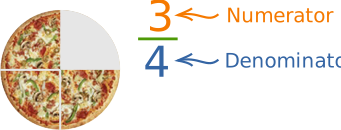
The top part (the numerator) says how many parts we have.
The bottom part (the denominator) says how many parts the whole is divided into.
See Fractions for more details.
A Decimal Number is ...
... a number that contains a Decimal Point.
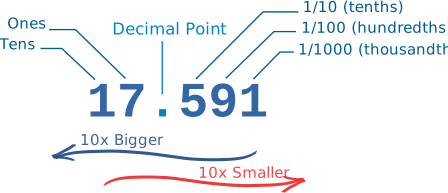
See Decimals for more details.
A Percentage is ...
... parts per 100. The symbol is %
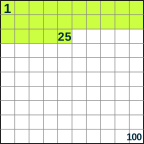
Example: 25% means 25 per 100 (25% of this box is green)
See Percentages for more details.
Average (Mean) is ...
... the sum divided by the count.
We calculate the average by adding up all the values, then divide by how many values.
Example: What is the average of 9, 2, 12 and 5?
Add up all the values: 9 + 2 + 12 + 5 = 28
Divide by how many values (there are four of them): 28 ÷ 4 = 7
So the average is 7
See Mean for more details.