Grouped Frequency Distribution
Frequency
Frequency is how often something occurs.
Example: Sam played football on:
- Saturday Morning,
- Saturday Afternoon
- Thursday Afternoon
The frequency was 2 on Saturday, 1 on Thursday and 3 for the whole week.
Frequency Distribution
By counting frequencies we can make a Frequency Distribution table.
Example: Newspapers
These are the numbers of newspapers sold at a local shop over the last 10 days:
22, 20, 18, 23, 20, 25, 22, 20, 18, 20
Let us count how many of each number there is:
| Papers Sold | Frequency |
|---|---|
| 18 | 2 |
| 19 | 0 |
| 20 | 4 |
| 21 | 0 |
| 22 | 2 |
| 23 | 1 |
| 24 | 0 |
| 25 | 1 |
It is also possible to group the values. Here they are grouped in 5s:
| Papers Sold | Frequency |
|---|---|
| 15-19 | 2 |
| 20-24 | 7 |
| 25-29 | 1 |
Grouped Frequency Distribution
We just saw how we can group frequencies. It is very useful when the scores have many different values.
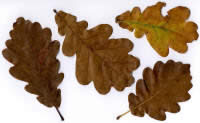
Example: Leaves
Alex measured the lengths of leaves on the oak tree (to the nearest cm):
9,16,13,7,8,4,18,10,17,18,9,12,5,9,9,16,1,8,17,1,
10,5,9,11,15,6,14,9,1,12,5,16,4,16,8,15,14,17
Let's try to group them, but what groups should we use?
To get started, put the numbers in order, then find the smallest and largest values in your data, and calculate the range (range = largest - smallest).
Example: Leaves (continued)
In order the lengths are:
1,1,1,4,4,5,5,5,6,7,8,8,8,9,9,9,9,9,9,10,10,11,12,12,
13,14,14,15,15,16,16,16,16,17,17,17,18,18
The smallest value (the "minimum") is 1 cm
The largest value (the "maximum") is 18 cm
The range is 18−1 = 17 cm
Group Size
Now calculate an approximate group size, by dividing the range by how many groups you would like.
Then round that group size up to some simple value (like 2 instead of 1.83 or 5 instead of 4.26).
Example: Leaves (continued)
Let us say we want about 5 groups.
Divide the range by 5:
Then round that up to 4
Start Value
Pick a starting value that is less than or equal to the smallest value. Try to make it a multiple of the group size if you can.
In our case a start value of 0 makes the most sense.
Groups
Now calculate the list of groups. (We must go up to or past the largest value).
Example: Leaves (continued)
Starting at 0 and with a group size of 4 we get: 0, 4, 8, 12, 16
Write down the groups.
Include the end value of each group that must be less than the next group:
| Length (cm) | Frequency |
|---|---|
| 0-3 | |
| 4-7 | |
| 8-11 | |
| 12-15 | |
| 16-19 |
The last group goes to 19 which is greater than the largest value. That is OK: the main thing is that it must include the largest value.
(Note: If you don't like the groups, then go back and change the group size or starting value and try again.)
Upper and Lower Values For Each Group
Even though Alex only measured in whole numbers, the data is continuous, so "4 cm" means the actual value could have been anywhere from 3.5 cm to 4.5 cm. Alex just rounded the numbers to whole centimeters.
Example: Leaves (continued)
Here are the groups with the Lower and Upper limits shown:
| Length | Lower/Upper | Frequency |
|---|---|---|
| 0-3 cm | 0-3.5 | |
| 4-7 cm | 3.5-7.5 | |
| 8-11 cm | 7.5-11.5 | |
| 12-15 cm | 11.5-15.5 | |
| 16-19 cm | 15.5-19.5 |
Tally and Total
Now tally the results to find the frequencies. And do a total.
Example: Leaves (continued)
1,1,1,4,4,5,5,5,6,7,8,8,8,9,9,9,9,9,9,10,10,11,12,12,
13,14,14,15,15,16,16,16,16,17,17,17,18,18:
| Length | Lower/Upper | Frequency |
|---|---|---|
| 0-3 cm | 0-3.5 | 3 |
| 4-7 cm | 3.5-7.5 | 7 |
| 8-11 cm | 7.5-11.5 | 12 |
| 12-15 cm | 11.5-15.5 | 7 |
| 16-19 cm | 15.5-19.5 | 9 |
| Total: | 38 |
Histogram
You might also like to make a Histogram of your data.