Complementary Angles
Two angles are Complementary when they
add up to 90 degrees (a Right Angle  )
)
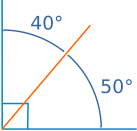
These two angles (40° and 50°) are Complementary Angles, because they add up to 90°:
Notice that together they make a right angle
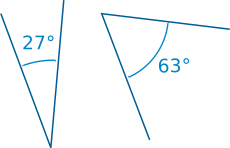
But the angles don't have to be together.
These two are complementary because 27° + 63° = 90°
Play With It ...
(Drag the points)
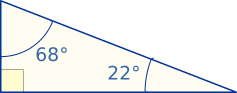
Right Angled Triangle
In a right angled triangle, the two non-right angles are complementary, because in a triangle the three angles add to 180°, and 90° has already been taken by the right angle.
When two angles add to 90°, we say they "Complement" each other.
Complementary comes from Latin completum meaning "completed" ...
because the right angle is thought of as being a complete angle.
Spelling: be careful, it is not "Complimentary Angle" (with an "i") ...
that would be an angle you get for free!
Complementary vs Supplementary
A related idea is Supplementary Angles - those add up to 180°
How to remember which is which? Well, alphabetically they are:
- Complementary add to 90°
- Supplementary add to 180°
You can also think:
- "C" of Complementary is for "Corner" (a Right Angle), and
- "S" of Supplementary is for "Straight" (180° is a straight line)
Or you can think:
- when you are right you get a compliment (sounds like complement)
- "supplement" (like a vitamin supplement) is something extra, so is bigger