Pythagorean Theorem Algebra Proof
What is the Pythagorean Theorem?
You can learn all about the Pythagorean theorem, but here is a quick summary:
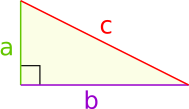
The Pythagorean theorem says that, in a right triangle, the square of a (which is a×a, and is written a2) plus the square of b (b2) is equal to the square of c (c2):
a2 + b2 = c2
Proof of the Pythagorean Theorem using Algebra
We can show that a2 + b2 = c2 using Algebra
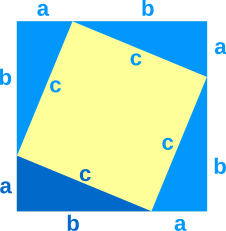
Take a look at this diagram ... it has that "abc" triangle in it (four of them actually):
Area of Whole Square
It is a big square, with each side having a length of a+b, so the total area is:
A = (a+b)(a+b)
Area of The Pieces
Now let's add up the areas of all the smaller pieces:
Both Areas Must Be Equal
The area of the large square is equal to the area of the tilted square and the 4 triangles. This can be written as:
(a+b)(a+b) = c2 + 2ab
NOW, let us rearrange this to see if we can get the Pythagorean theorem:
DONE!
Now we can see why the Pythagorean theorem works ... and it is actually a proof of the theorem.
This proof came from China over 2000 years ago!
There are many more proofs of the Pythagorean theorem, but this one works neatly.