Radians
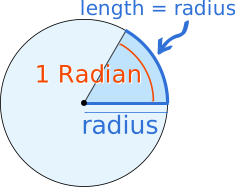
The angle made when the radius is wrapped around the circle:
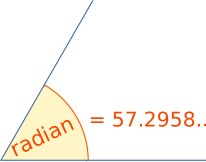 |
1 radian is about 57.2958 degrees. |
Why "57.2958..." degrees? Let's discover why.
The radian is a pure measure based on the Radius of the circle
Radian: the angle made when we take the radius
and wrap it round the circle.
Radians and Degrees
Let's see why 1 radian equals 57.2958... degrees (press play):
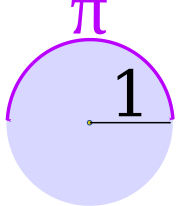
In a half circle there are π radians, which is also 180°
To go from radians to degrees: multiply by 180, divide by π
To go from degrees to radians: multiply by π, divide by 180
Here is a table of some common angles in both degrees and radians:
| Degrees | Radians (exact) |
Radians (approx) |
|---|---|---|
| 30° | π/6 | 0.524 |
| 45° | π/4 | 0.785 |
| 60° | π/3 | 1.047 |
| 90° | π/2 | 1.571 |
| 180° | π | 3.142 |
| 270° | 3π/2 | 4.712 |
| 360° | 2π | 6.283 |
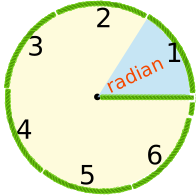
Example: How Many radians in a Full Circle?
Imagine cutting pieces of string, each the same length as the radius of a circle.
How many pieces do you need to go once around the circle?
Answer: 2π (or about 6.283 pieces of string).
Radians Preferred by Mathematicians
Since a radian is based on the pure idea of "laying the radius along the circumference" it leads to cleaner, more natural results in mathematics.
Small Angles
For small angles the values of sine and tangent are almost equal to the value of the angle in radian:
| x (radians) | sin(x) | tan(x) |
|---|---|---|
| 1 | 0.8414710 | 1.55740772 |
| 0.1 | 0.0998334 | 0.1003347 |
| 0.01 | 0.0099998 | 0.0100003 |
Here we can see the tan function on a triangle for smaller and smaller angles:
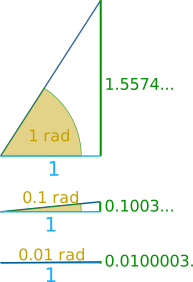
At 0.01 radians both sin and tan are within 0.003% of the radian value.

Example: A road rises 1 m for every 100 m along. What is its angle in degrees (without using a calculator)?
1 in 100 is 0.01, and tan(0.01) is approximately 0.01 radians
We also know that 1 radian is about 57 degrees, so 0.01 radians is about 0.57 degrees
Also the cosine function approaches 1 for small radian values.
| x (radians) | cos(x) |
|---|---|
| 1 | 0.540302... |
| 0.1 | 0.995004... |
| 0.01 | 0.999950... |
Conclusion
Degrees are easier to use in everyday work, but radians are much better for mathematics.