Powers of 10: Writing Big and Small Numbers
Powers of 10 help us handle large and small numbers efficiently.
Let's explore how they work!
The Exponent (or index or power) of a number says how many times to use the number in a multiplication:
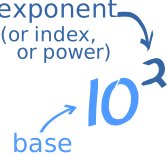
It says to take 10 and use it 2 times in a multiplication:
102 = 10 × 10 = 100
Example: 103 = 10 × 10 × 10 = 1,000
- In words: 103 could be called "10 to the third power", "10 to the power 3" or simply "10 cubed"
Example: 104 = 10 × 10 × 10 × 10 = 10,000
- In words: 104 could be called "10 to the fourth power", "10 to the power 4" or "10 to the 4"
We can multiply any number by itself as many times as we want this way ...
... but powers of 10 have a special use!
Powers of 10
"Powers of 10" is a very useful way of writing down large or small numbers.
Instead of having lots of zeros, we show how many powers of 10 make that many zeros
Example: 5,000 = 5 × 1,000 = 5 × 10³
5 thousand is 5 times a thousand
And a thousand is 103
So 5,000 = 5 times 103
Can you see that 103 is a handy way of making 3 zeros?
Engineers and scientists (who often use very big or very small numbers) like to write numbers this way.

Example: The Mass of the Sun
The Sun has a Mass of 1.988 × 1030 kg.
It is too hard to write 1,988,000,000,000,000,000,000,000,000,000 kg
(And very easy to make a mistake counting the zeros!)
Example: A Light Year (the distance light travels in one year)
It is easier to use 9.461 × 10¹⁵ meters, rather than 9,461,000,000,000,000 meters
It is commonly called Scientific Notation, or Standard Form.
Another Way of Writing It
Sometimes people use the ^ symbol (above the 6 on your keyboard), as it is easy to type.
Example: 3 × 10^4 is the same as 3 × 10⁴
3 × 10^4 = 3 × 10 × 10 × 10 × 10 = 30,000
Most calculators use "E" or "e", so 6E+5 means 6 × 10⁵. "E" stands for exponent.
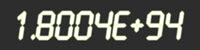
Example: 6E+5 is the same as 6 × 10⁵
6E+5 = 6 × 10 × 10 × 10 × 10 × 10 = 600,000
Example: 3.12E4 is the same as 3.12 × 10⁴
3.12E4 = 3.12 × 10 × 10 × 10 × 10 = 31,200
A Simple Trick
At first it may look hard, but there is an easy "trick":
The index of 10 says ...
... how many places to move the decimal point to the right.
Example: What is 1.35 × 10⁴ ?
You can calculate it as:
1.35 x (10 × 10 × 10 × 10) = 1.35 × 10,000 = 13,500
But it is easier to think "move the decimal point 4 places to the right" like this:

Negative Powers of 10
What happens when we use negative powers? Instead of making numbers bigger, we make them smaller, just like dividing!
So we divide by 10 each time, which is the same as multiplying by 110
Example: What is 5 × 10⁻³ ?
5 × 10-3 = 5 × 110 × 110 × 110
= 0.005
Example: A human hair is about 6 × 10⁻⁵ meters wide.
6 × 10-5 = 0.000 06

Example: A red blood cell is about 7 × 10⁻⁶ meters wide
7 × 10-6 = 0.000 007
We can use this handy rule:
For negative powers of 10, move the decimal point left.
So negative powers just go the other way.
Example: What is 7.1 × 10⁻³ ?
We move the decimal point 3 places to the left like this:
Try It Yourself
Give it a go! Type any number and see how it looks in scientific notation
Now try to use scientific notation yourself:
Summary
The index of 10 says how many places to move the decimal point. Positive means move it to the right, negative means to the left. Example:
| Number |
In Scientific Notation |
In Words | |
| Positive Powers | 5,000 | 5 × 10³ | 5 Thousand |
| Negative Powers | 0.005 | 5 × 10⁻³ | 5 Thousandths |