Metric Numbers
(See also Metric/US Customary Conversion Charts and Unit Converter)
What's kilo, mega, giga, tera ... ?
In the Metric System there are standard ways to talk about big and small numbers:
- "kilo" for a thousand,
- "mega" for a million,
- and more ...

Example: A long rope measures one thousand meters
It is easier to say it is 1 kilometer long,
and even easier to write it down as 1 km.
So we used kilo in front of the word meter to make "kilometer".
And the abbreviation is "km" (k for kilo and m for meter, put together).
Some more examples:

Example: Weight
You put your backpack on a set of scales and it shows 2000 grams, we can call that 2 kilograms, or simply 2 kg.
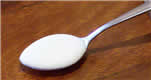
Example: Teaspoon
A teaspoon holds 5 thousandths of a liter (51000 of a liter), but it is better to say "5 milliliters", or write it simply as 5 mL.
"kilo", "mega", "milli" and so on are called "prefixes":
Prefix: a word part that can be added to the beginning of another word to create a new word
So, using the prefix "milli" in front of "liter" creates a new word "milliliter".
Here we list the prefix for commonly used big and small numbers:
Common Big and Small Numbers
| Name | The Number | Prefix | Symbol |
|---|---|---|---|
| trillion | 1,000,000,000,000 | tera | T |
| billion | 1,000,000,000 | giga | G |
| million | 1,000,000 | mega | M |
| thousand | 1,000 | kilo | k |
| hundred | 100 | hecto | h |
| ten | 10 | deka | da |
| unit | 1 | ||
| tenth | 0.1 | deci | d |
| hundredth | 0.01 | centi | c |
| thousandth | 0.001 | milli | m |
| millionth | 0.000 001 | micro | µ |
| billionth | 0.000 000 001 | nano | n |
| trillionth | 0.000 000 000 001 | pico | p |
Just remember for large values (each one a thousand times bigger):
"kilo mega giga tera"
and for small values (each one a thousand times smaller):
"milli micro nano pico"
Most metric prefixes change by 1,000 each step, but a few common ones change by 10 or 100 instead:
- deka = ×10
- hecto = ×100 (1 hectoliter = 100 liters)
- deci = ÷10
- centi = ÷100 (1 centimeter = 1/100 meter)
Try To Do Some Yourself!
- How do you refer to a million liters?
- How about one billionth of a meter?
See the bottom of this page for more questions to challenge yourself ...
How Big Are They?
There's a lot of difference between them. Think in terms of time:
A billion seconds is about 32 years
A longer list:
- A thousand seconds is about a quarter of an hour
- A million seconds is about 12 days
- A billion seconds is about 32 years, almost half a lifetime
- A trillion seconds is about 32,000 years (the last Ice Age finished 12,000 years ago)
Much Bigger and Smaller
There are also prefixes for much bigger and smaller numbers:
Some Very Big, and Very Small Numbers
| Name | The Number | Prefix | Symbol |
|---|---|---|---|
| Very Big ! | |||
| nonillion | 1,000,000,000,000,000,000,000,000,000,000 | quetta | Q |
| octillion | 1,000,000,000,000,000,000,000,000,000 | ronna | R |
| septillion | 1,000,000,000,000,000,000,000,000 | yotta | Y |
| sextillion | 1,000,000,000,000,000,000,000 | zetta | Z |
| quintillion | 1,000,000,000,000,000,000 | exa | E |
| quadrillion | 1,000,000,000,000,000 | peta | P |
| Very Small ! | |||
| quadrillionth | 0.000 000 000 000 001 | femto | f |
| quintillionth | 0.000 000 000 000 000 001 | atto | a |
| sextillionth | 0.000 000 000 000 000 000 001 | zepto | z |
| septillionth | 0.000 000 000 000 000 000 000 001 | yocto | y |
| octillionth | 0.000 000 000 000 000 000 000 000 001 | ronto | r |
| nonillionth | 0.000 000 000 000 000 000 000 000 000 001 | quecto | q |
(SI added ronna/quetta and ronto/quecto in 2022.)
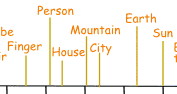 |
Also see Lengths From Very Small to Very Large |
All Big Numbers We Know
| Name | As a Power of 10 | As a Decimal |
|---|---|---|
| Thousand | 103 | 1,000 |
| Million | 106 | 1,000,000 |
| Billion | 109 | 1,000,000,000 |
| Trillion | 1012 | 1,000,000,000,000 |
| Quadrillion | 1015 | and so on ... |
| Quintillion | 1018 | |
| Sextillion | 1021 | |
| Septillion | 1024 | |
| Octillion | 1027 | |
| Nonillion | 1030 | |
| Decillion | 1033 | |
| Undecillion | 1036 | |
| Duodecillion | 1039 | |
| Tredecillion | 1042 | |
| Quattuordecillion | 1045 | |
| Quindecillion | 1048 | |
| Sexdecillion | 1051 | |
| Septemdecillion | 1054 | |
| Octodecillion | 1057 | |
| Novemdecillion | 1060 | |
| Vigintillion | 1063 | 1 followed by 63 zeros! |
And a Googol is 1 followed by one hundred zeros (10100) :
10,000,000,000,000,000,000,000,000,000,000,000,
000,000,000,000,000,000,000,000,000,000,000,
000,000,000,000,000,000,000,000,000,000,000
Then there's the Googolplex. It is 1 followed by Googol zeros. I can't even write down the number, because there's not enough matter in the observable universe to form all the zeros:
10,000,000,000,000,000,000,000,000,000,000, ... (Googol number of Zeros)
And a Googolplexian is a 1 followed by Googolplex zeros. Wow.
All Small Numbers We Know
| Name | As a Power of 10 | As a Decimal |
|---|---|---|
| thousandths | 10-3 | 0.001 |
| millionths | 10-6 | 0.000 001 |
| billionths | 10-9 | 0.000 000 001 |
| trillionths | 10-12 | and so on ... |
| quadrillionths | 10-15 | |
| quintillionths | 10-18 | |
| sextillionths | 10-21 | |
| septillionths | 10-24 | |
| octillionths | 10-27 | |
| nonillionths | 10-30 | |
| decillionths | 10-33 | |
| undecillionths | 10-36 | |
| duodecillionths | 10-39 | |
| tredecillionths | 10-42 | |
| quattuordecillionths | 10-45 | |
| quindecillionths | 10-48 | |
| sexdecillionths | 10-51 | |
| septemdecillionths | 10-54 | |
| octodecillionths | 10-57 | |
| novemdecillionths | 10-60 | |
| vigintillionths | 10-63 |