Reciprocal
The reciprocal is simply: 1/number
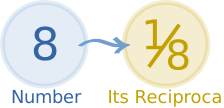
To get the reciprocal of a number, we divide 1 by the number.
Example: the reciprocal of 2 is ½ (a half)
More Examples:
| Number | Reciprocal | As a Decimal |
|---|---|---|
| 5 | 15 | = 0.2 |
| 8 | 18 | = 0.125 |
| 1000 | 11000 | = 0.001 |
Like Turning the Number Upside Down
 |
We can think of a whole number as being "number/1", so the reciprocal is like "flipping it over":
|
For Fractions, Flip the Whole Fraction Over
Example: the reciprocal of 3/4 is 4/3
Read more at Reciprocal of a Fraction.

Flipping a Flip
The reciprocal of a reciprocal takes us back to where we started:
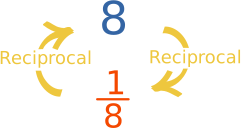
Example:
The reciprocal of 4 is 1/4
The reciprocal of 1/4 is 4 (back to 4 again)
It may help to remember that "Reciprocal" comes from the Latin reciprocus meaning returning. Like going to the shops and then returning home again.
But Not Zero
Every number has a reciprocal except 0 (1/0 is undefined)
Multiplying a Number by Its Reciprocal
Let us try multiplying a number by its reciprocal:
How about another:
Try some more yourself! You should always get 1
And that is a way to define Reciprocal:
Reciprocal: what to multiply a value by to get 1
The reciprocal is also called the "Multiplicative Inverse".