Activity: How High?
Aim
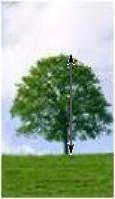
The aim of this activity is to measure the height of a tall building or tree.
We'll illustrate this with a tree, but the method is just the same for a building.
For this activity you will need:
- A piece of cardboard or thin sheet of wood, about the size of a sheet of paper
- A piece of string about 30cm or 1 foot long:
- A drawing pin (thumbtack) or a small nail:

- A small rock (one you can tie the string to):

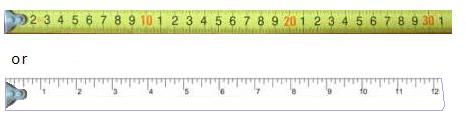
- A tape measure:
- scissors
- glue
Measuring the height.
Can I just measure it with a tape measure?
That won't be easy. You may have to climb the tree to do that. Dangerous!
But there's another, easier, way!
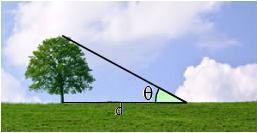
Measure a length along the ground and measure the angle θ to the top of the tree:
Surveyors and engineers use special equipment to measure these distances and angles accurately. The instrument they use to measure the angle is called a theodolite. In this activity you will make a simple theodolite. You won't get accurate answers, but it will help you to understand how surveyors do their work.
There are three parts to this activity:
- Making a simple theodolite
- Measuring the angle and the distance along the ground
- Using the measurements to find the height of the tree
Making a Simple Theodolite
Step 1: Print out this image of a protractor onto A4 paper.
You will need to change the page orientation to landscape.
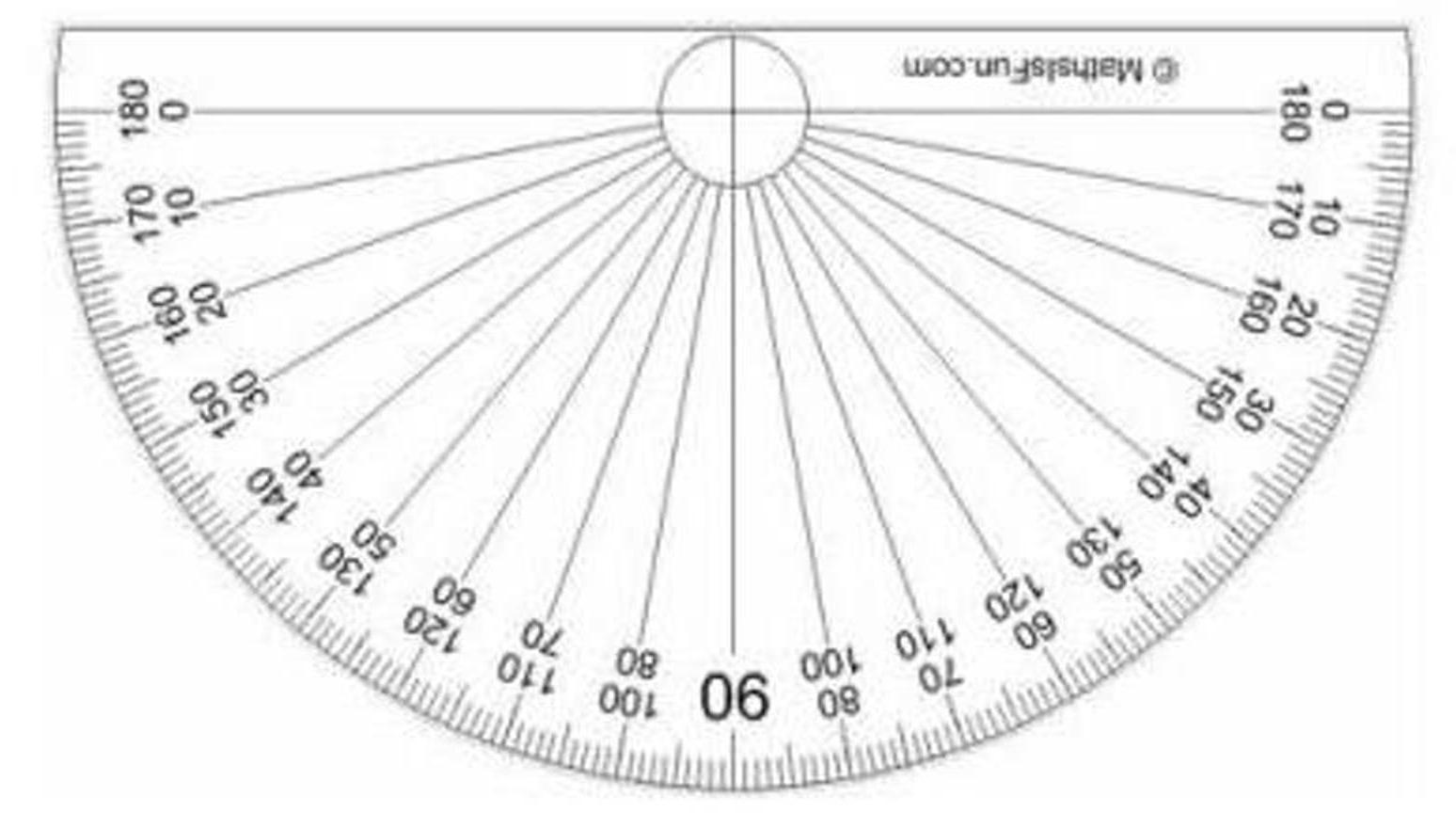
Step 2: You don't need to cut out the picture of the protractor, but you will need to cut as near as you can to the top edge - just leave a small space, enough for you to attach the drawing pin or nail.
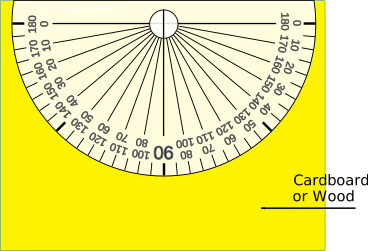
Step 3: Glue your picture of the protractor with its straight-edge lying along the
top edge of your cardboard or timber:
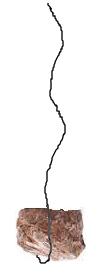
Step 4: Tie the small rock to one end of the piece of string:
Step 5: Attach the other end of the string to the top middle point of the
protractor using the drawing pin or nail:
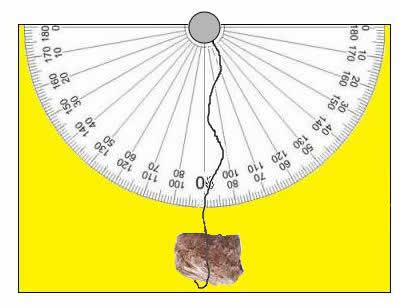
When you allow the rock to pull the string downwards, gravity will make it hang vertically. Even if you tilt the piece of cardboard or timber at an angle, the string will still hang vertically:
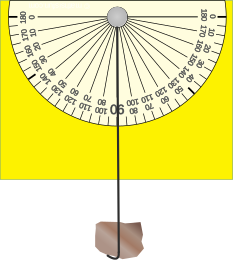
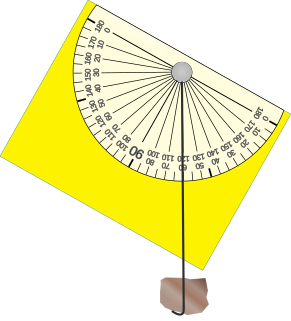
Reading the Angle:
When held level, the string hangs straight down at 90°
When we tilt it up by 30°, the string moves to 60°
Measuring the Angle and the Distance Along the Ground
First of all, find a good place to stand about 100 feet or 30m away from the tree. Make sure that you are standing on level ground and in a safe place. Mark the place with a stick. Now you are ready to measure.
To measure the angle, you just point your 'theodolite'' toward the top of the tree. Put your eye as close as possible to one edge of the protractor; then, looking along the straight edge, point it directly at the top of the tree:
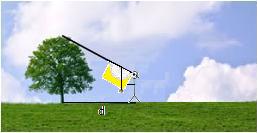
Hold the string and weight in position before you lower theodolite. Then read the angle from theodolite as the angle the vertical weight on the string makes with the protractor. Adjust your answer to find the angle of elevation, θ, from your eye to the top of the tree.
To find the distance, d, use your tape measure to measure from the stick to the base of the tree, or more exactly to the midpoint of the base of the tree - can you see how to make allowance for that?
Using the Measurements to Find the Height of the Tree
You can calculate the height of the tree using a scale diagram on a piece of paper,
following these steps:
- Draw a horizontal line:
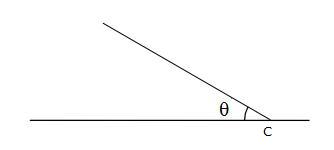
- At a point, C, near the right end of the line, measure an angle equal to the angle, θ, from your experiment:
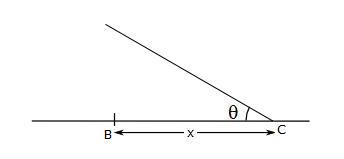
- Choosing a suitable scale, measure the distance x equivalent to the distance d you measured in your experiment. Mark a point B:
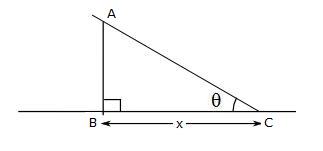
- Draw the perpendicular at B to meet the sloping line at A:
- Measure the height, y, of A above B:
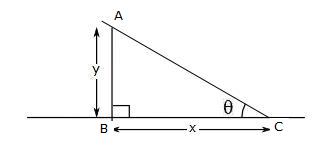
- Using the scale from step 3, convert y back to find the height, h, of the tree
Wait!
- Did you notice anything wrong?
- Where was your eye when you measured the angle θ?
- Can you think of a way to compensate for that error?
You were holding theodolite at your eye, not on the ground! So your calculation gave you the height from your eye level to the treetop.
Total Tree Height = Calculated Height + Eye Height
Another Way
Instead of drawing a scale diagram, you can use the tangent function from trigonometry:
In your right triangle:
tan(θ) = OppositeAdjacent = Height above eyed
Rearranging gives:
Height above eye = d × tan(θ)
Then add your eye height:
Total Height = (d × tan(θ)) + Eye Height
To Finish Up
Can you list below some things about this experiment that tell you that your answer isn't very accurate?
Any more?
- Try to discover how a real theodolite is made and why it gives much more accurate measurements.