Making Sense of Data
Data tells a story.
When we look at data, we often want to know how values are similar or different. We compare data to answer questions like:
- Which group has more or less?
- Are the amounts about the same?
- How big is the difference?
We want to move beyond just the numbers to discover what the data is telling us about the real world.
Comparing Amounts
To make a comparison we can look at the size of each group. This can be done using numbers, tables, or graphs.
Useful comparison words include:
- equal
- about the same ($30 and $31 are about the same)
- similar (200 mL and 230 mL are similar in volume)
- less than, more than
- lower, higher
- least, most
- smallest, greatest
Example: How Big Is the Difference?
A fruit survey shows:
| Apples | Bananas |
|---|---|
| 18 | 12 |
- More: Apples (18) is more than Bananas (12)
- Difference: 18 − 12 = 6, so 6 more people chose apples
- Meaning: Apples was the more popular choice
We can also use equality symbols:
18 > 12 (18 is greater than 12)
This same idea is used when we compare data values in tables or graphs.
(See also: Comparing Numbers)
Comparing Data Using Graphs
Graphs help us see differences quickly. By comparing heights, lengths, or areas, we can tell which values are larger or smaller.
Bar Graphs
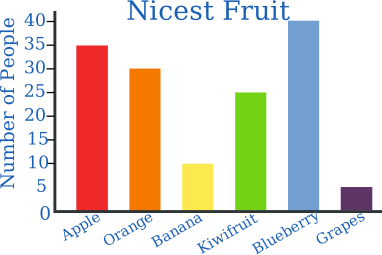
In a bar graph, we compare values by looking at the height of the bars.
Example: Bar Graph Comparison
- When one bar is taller than another, it means a greater quantity
- Apples were preferred more than Oranges by 35 − 30 = 5
Line Graphs (Comparing Over Time)
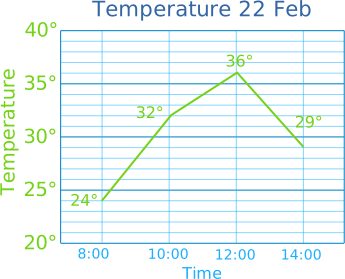
Line graphs let's compare trends.
Putting two lines on one graph can show us when they move in the same direction and when one is changing faster than the other.
Learn more here: Bar Graphs | Make a Bar Graph | Line Graphs | Pie Charts
Describing Similarities and Differences
When looking at data, we do more than just point to numbers. We describe what the data is telling us.
Good descriptions often include:
- Which group is the largest or smallest
- Whether groups are close in value or far apart
- Any patterns we notice
Example: Describing Differences
The number of people who drive to the pool is much higher than the number who ride bikes. The bus and car groups are about the same size.
Comparing Sets of Data
Sometimes we compare whole sets of data, not just single values. We may look at:
- Which set has larger values overall
- Which set is more spread out
- How two sets are similar or different
Example: Comparing Two Sets (Overall and Spread)
Team A travel times (minutes): 10, 12, 13, 15, 16
Team B travel times (minutes): 5, 10, 14, 20, 25
- Overall lower: Team A has most values around 13
- More spread out: Team B is on average higher, and also more spread out
So the groups are different: one is steadier, the other varies a lot.
This idea is explored further when learning about:
Key Ideas to Remember
- We compare data to understand differences and similarities
- Graphs make comparisons easier to see
- Good data interpretation uses clear comparison words
- Always explain what the data shows, not just the numbers