Pyramids
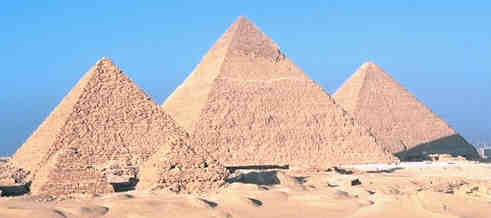
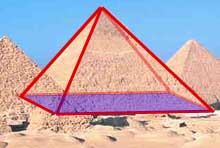
When we think of pyramids, the Great Pyramids of Egypt often come to mind.
They are actually Square Pyramids, because their base is square.
Parts of a Pyramid
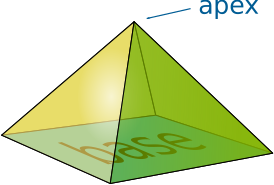
A pyramid is made by connecting a base to an apex
The base is a polygon (flat with straight edges) and all other faces are triangles. No curves!
Types of Pyramids
There are many types of Pyramids, and they are named after the shape of their base.
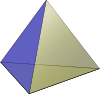



Fly through some pyramids here.
Right vs Oblique Pyramid
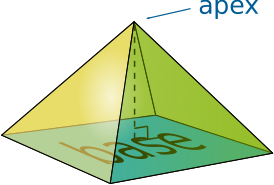
This tells us where the top (apex) of the pyramid is. When the apex is directly above the center of the base it is a Right Pyramid, otherwise it is an Oblique Pyramid.
 |
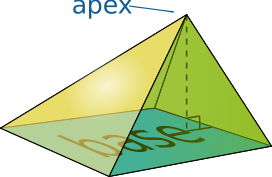 |
| Right Pyramid | Oblique Pyramid |
|---|
Regular vs Irregular Pyramid
This tells us about the shape of the base. When the base is a regular polygon it is a Regular Pyramid, otherwise it is an Irregular Pyramid.
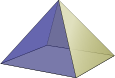
Regular Pyramid

Base is Regular

Irregular Pyramid

Base is Irregular
Area and Volume
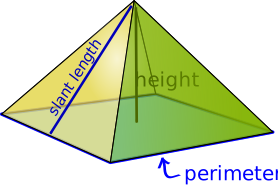
The Volume of a Pyramid
Volume = 13 × [Base Area] × height
• Height is the vertical distance straight down
• Slant length is the distance along the sloping side face from the apex to edge
The Surface Area of a Pyramid
The Surface Area has two parts: the Base Area, and the Lateral Area (area of the side faces).
The Base Area depends on the shape of the base. Triangles, squares, and so on, each have their own formulas. See Area or the Area Calculation Tool.
For Lateral Area:
- When all side faces are the same: multiply the perimeter by the slant length and divide by 2. This works because each side face is a triangle and the area of a triangle is base times height divided by 2
- When the side faces are different (such as an irregular pyramid) we must add up the area of each triangle to find the total lateral area
So we have:
When side faces are all the same:
[Base Area] + 12 × Perimeter × [Slant Length]
When side faces are different:
[Base Area] + [Lateral Area]
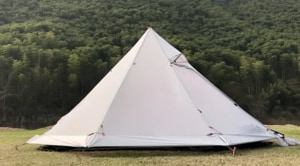
Example: Pyramid Tent Surface Area
Alex wants to waterproof this tent, so needs to find its lateral surface area (not its base) to order the spray.
Running a tape measure all around the base gets 9 m, and from the top down to the bottom edge is 1.8 m.