Solids of Revolution
DRAFT
Let's start by learning about Cross-Sections and Rotation.
Cross-Sections
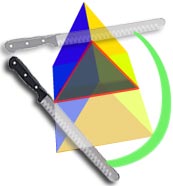
A cross section is the shape you get when cutting straight across an object.
 |
|
It is like a view into the inside of something made by cutting through it.
| This is a cross-section of a piece of celery. |  |
A solid has more than one cross-section, depending on which way you cut through it.
The most important cross-sections are:
- The horizontal cross-section, when we cut straight across the solid
- The vertical cross-section, when we cut straight down the solid vertically
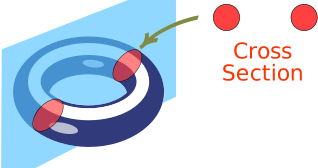
They are not views "from above" or "from the side", they are cuts through the solid.
Example: this cross section through a torus is two circles!
Rotation in a plane
"Rotation" means turning around a center:
The distance from the center to any point on the shape stays the same.
Every point makes a circle around the center.
Here, we need to see what happens when we rotate a line segment
A line segment is part of a line connecting two points. It has definite end points. The word "segment" is important, because a line normally extends in both directions without end.
We want to rotate a line segment one complete turn (360) about a center of rotation.
Note that it doesn’t matter whether the rotation is clockwise or counterclockwise. It’s the path or locus that we are interested in.
There are three cases to consider:
1. When the center of rotation is at one of the endpoints.
In this case we have a line segment AB and the center of rotation is at B
A rotates on a circle with center B and radius AB
2. When the center of rotation is a point on the line segment between A and B.
A rotates on a circle with center O and radius AO and B rotates on a smaller circle with center O and radius BO.
(Note that we have put O closer to B than A, but it could be anywhere on the line segment. If it is at the midpoint of AB, then the two circles are the same size.)
3. When the center of rotation is a point outside the line segment AB, but on the line through AB.
A rotates on a circle with center O and radius AO and B rotates on a smaller circle with center O and radius BO.
(Note that we have put O on AB produced, but it could be anywhere on the line going through A and B.)
Three Dimensions
Now, we will move up to three dimensions.
Solid Geometry is the geometry of three-dimensional space, the kind of space we live in ... |
||
It is called three-dimensional, or 3D because there are three dimensions: width, depth and height.
|
||
Rotation about an axis in three dimensions perpendicular to the plane
What is a plane?
A plane is a flat surface with no thickness. It extends forever. We often draw a plane with edges, but it really has no edges.
Now we will consider each of the three cases when the line segment is rotated about an axis that is perpendicular to the plane containing the line segment AB:
1. When the axis of rotation is at one of the endpoints.
In this case the axis of rotation, L, passes through B and is perpendicular to the plane containing AB:
A rotates on a circle with center B and radius AB in the same plane as AB and perpendicular to L.
2. When the axis of rotation is perpendicular to a point O on the line segment AB.
A rotates on a circle with center O and radius AO and B rotates on a smaller circle with center O and radius BO.
3. When the axis of rotation passes through a point O outside the line segment AB, but on the line passing through A and B.
A rotates on a circle with center O and radius AO and B rotates on a smaller circle with center O and radius BO.
Rotating a plane geometrical figure about the axis L
Now, let’s see what happens when we rotate a plane geometrical figure one complete turn (360) about the axis L.
The simplest case is a rectangle ABCD:
1. When the axis of rotation lies along one edge of the rectangle.
In this case the axis of rotation, L, passes through B and C and is perpendicular to the plane containing AB and the plane containing DC:
A rotates on a circle with center B and radius AB in the same plane as AB and perpendicular to L
and D rotates on a circle with center C and radius DC in the same plane as DC and perpendicular to L.
The resulting solid is a cylinder of height AD and base radius AB...
... and
the horizontal cross-section is a circle of radius AB
the vertical cross-section is two rectangles joined together:
This example shows that:
Points that lie on the axis of rotation do not move under the rotation.
All other points move around a circle.
2. When the axis of rotation is perpendicular to a point O on the side AB and a point P on the side DC.
A rotates on a circle with center O and radius AO and B rotates on a smaller circle with center O and radius BO.
D rotates on a circle with center P and radius DP and C rotates on a smaller circle with center P and radius CP.
The resulting solid is a cylinder of height AD and base radius AO...
... and
the horizontal cross-section is a circle of radius AO with another concentric circle of radius BO inside it
the vertical cross-section is two overlapping rectangles:
This example shows that:
Points that lie closer to the axis of rotation rotate around a smaller circle than points further away.
3. When the axis of rotation passes through a point O on AB produced and a point P on DC produced with DP and AO both perpendicular to L.
A rotates on a circle with center O and radius AO and B rotates on a smaller circle with center O and radius BO.
D rotates on a circle with center P and radius DP and C rotates on a smaller circle with center P and radius CP.
The resulting solid is a cylinder of height AD and base radius AO with another cylinder of the same height and base radius BO cut out from its center i.e. a cylinder with a cylindrical hole in it...
... and
the horizontal cross-section is an annulus:
the vertical cross-section is two rectangles:
This example shows that:
If all points in the plane figure lie outside the axis of rotation, then there is a hole.
In all cases, points move around circles and the horizontal cross-section of the solid figure is made up of circles.
Example 1
Equilateral triangle ABC is rotated a complete turn around axis L. What is the solid of revolution?
A rotates around a circle of radius OA.
B and C lie on the axis L, so do not move under the rotation. They become the vertices of two congruent cones (one up the right way and one upside down) joined at the circle made by A.
Example 2
The circle center O is rotated a complete turn around axis L. Point A lies on the circumference of the circle and on L.
What is the solid of revolution?
A lies on the axis, so does not move under the rotation. The circle is rotated about A in the plane perpendicular to L. It’s quite hard to visualize, but it makes a special kind of torus with a dimple at the center, sometimes called a roman cushion:
A different axis
In all the above examples the axis of rotation L has been shown as a vertical axis. Of course, it doesn’t have to be. Let’s try rotating the rectangle ABCD about M, the horizontal axis through A and B:
The resulting solid is a cylinder (on its side) of length AB and radius AD...
... and
the horizontal cross-section is two rectangles joined together:
the vertical cross-section is a circle of radius AD
Example 3
Rotate rectangle ABCD about the axis N that passes through the diagonal BD of the rectangle.
It might be easier first to rotate the whole diagram so that N is vertical:
Now we have two triangles ABD and CBD that must rotate around N.
Points A and C rotate around circles with centers O and P respectively, but B and D are on the axis, so do not move as a result of the rotation.
So the top part (the part above A) rotates in a similar way to the top triangle in Example 1. This makes a cone.
Similarly the bottom part (the part below C) rotates in a similar way to the bottom triangle in Example 1. This makes an inverted cone.
The part vertically between A and C makes a pair of truncated cones joined at the middle
So we get:
Now rotate the whole thing back so that AB and CD are once again horizontal:
Example 4
Rotate the square about the axis M.
It might be easier first to rotate the whole diagram so that M is vertical:
All points rotate around circles, but the four corners of the square move around circles of different radii.
So we get:
The solid formed is a bit like a torus, but the vertical cross section is a square instead of a circle.
Now rotate the whole thing back so that the sides of the square are once again horizontal and vertical: