Addition Tips and Tricks

Here are lots of "thinking tricks" you can use to make addition easier.
Use the ones that make sense to you!
Count From A Number Upwards
Example: 6 + 3
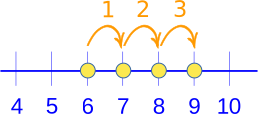
Think "6 ... 7, 8, 9"
Hint: start from the larger number.
Example: 2 + 6
2 + 6 is Harder: "2 ... 3, 4, 5, 6, 7, 8"
6 + 2 is Easier: "6 ... 7, 8"
So do 6 + 2 instead (you get the same answer).
Jump Strategy
We can also count by 2s or 10s, or make any "jumps" we want to help us solve a calculation.
Example: 4 + 12
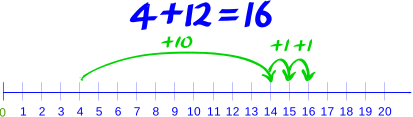
Think "4 ... 14 ... 15, 16"
Adding Up To Ten
See if any numbers add to 10. They don't have to be next to each other.
Example: 7 + 8 + 3 + 2 + 5
7+3 is 10,
8+2 is another 10, which makes 20,
Plus 5 is 25
Do The Tens Last
Break big numbers into Tens and Ones, add the Ones, then add on the Tens.
Example: 14+5
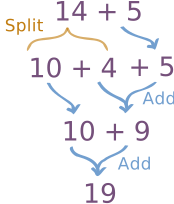
Break the "14" into Tens and Ones: 10 + 4
Add the Ones: 4 + 5 = 9
Now add the Tens: 10 + 9 = 19
Think "4 plus 5 is 9, plus 10 is 19"
Another Example: 14 + 12
Break into Tens and Ones: 10 + 4 + 10 + 2
Add the Ones: 4 + 2 = 6
Now add on the Tens: 6 + 10 + 10 = 26
Aim for Ten
When a number is close to ten we can "borrow" from the other number so it reaches ten.
|
images/add-aim-10.js |
Example: 9 + 79 is only 1 away from 10 |
|
so take 1 from the 7: 9 + 1 + 6 Think "9 plus 1 is 10 ... 7 less 1 is 6 ... together that's 16" |
|
Example: 8 + 5
8+2=10, so lets take 2 from the 5: 8 + 2 + 3
and give it to the 8: 10 + 3 = 13
We can also move backwards to ten, by making the other number bigger as needed:
Example: 12 + 7
Reduce 12 by 2: 12 − 2 = 10
Increase 7 by 2: 7 + 2 = 9
12 + 7 = 10 + 9 = 19
Compensation Method
"Compensation" is where you round up a number (to make adding easier) and then take away the extra after you have added.
Example 19+16
It is easier to do 20 + 16 = 36
Then take away the extra 1 (that made 19 into 20) to get: 35
Example 395 + 126
It is easier to do 400 + 126 = 526
Then take away the extra 5 (that made 395 into 400) to get: 521
Double When the Numbers Are the Same
When both numbers are the same, we can double one of them.
Example: 5 + 5
Double 5 is 10
Example: 8 + 8
Double 8 is 16
We can use a double to help with other additions.
Numbers That Are One Apart
When the numbers are one apart (like 6 and 7), we can start with a double and then fix it.
Example: 6 + 7
Start with the double of the smaller number:
6 + 6 = 12
And add 1:
6 + 7 = 12 + 1 = 13
Example: 8 + 9
Start with the double of the smaller number:
8 + 8 = 16
Add the extra 1:
8 + 9 = 16 + 1 = 17
When Numbers are Equally Far from a Middle
If two numbers are equally far from a middle number, we can just double the middle number!
Example: 7 + 9
The middle number is 8.
One number is 1 smaller, and the other is 1 bigger.
Those changes cancel out:
7 + 9 = 8 + 8 = 16
The Addition Table
We can also use the Addition Table to help us.