Complex Numbers

A Complex Number
A Complex Number is a combination of a
Real Number and an Imaginary Number
Real Numbers are numbers like:
Nearly any number you can think of is a Real Number!
Imaginary Numbers when squared give a negative result.
Normally this doesn't happen, because:
- when we square a positive number we get a positive result, and
- when we square a negative number we also get a positive result (because a negative times a negative gives a positive), for example −2 × −2 = +4
But just imagine such numbers exist, because we want them.
Let's talk some more about imaginary numbers ...
The "unit" imaginary number (like 1 for Real Numbers) is i, which is the square root of −1

When we square i we get −1
i2 = −1
Examples of Imaginary Numbers:
And we keep that little "i" there to remind us we still need to multiply by √−1
Be careful! While we write i = √−1, standard square root rules (like √a × √b = √(ab)) don't work with negative numbers.
It is always safest to use the rule i2 = −1 directly.
Complex Numbers
When we combine a Real Number and an Imaginary Number we get a Complex Number:

Examples:
Can a Number be a Combination of Two Numbers?

Can we make a number from two other numbers? Sure we can!
We do it with fractions all the time. The fraction 3/8 is a number made up of a 3 and an 8. We know it means "3 of 8 equal parts".
Well, a Complex Number is just two numbers added together (a Real and an Imaginary Number).
Either Part Can Be Zero
So, a Complex Number has a real part and an imaginary part.
But either part can be 0, so all Real Numbers and Imaginary Numbers are also Complex Numbers.
| Complex Number | Real Part | Imaginary Part | |
|---|---|---|---|
| 3 + 2i | 3 | 2 | |
| 5 | 5 | 0 | Purely Real |
| −6i | 0 | −6 | Purely Imaginary |
Complicated?

Complex does not mean complicated.
It means the two types of numbers, real and imaginary, together form a complex, just like a building complex (buildings joined together).
A Visual Explanation
You know how the number line goes left-right?
Well let's have the imaginary numbers go up-down:
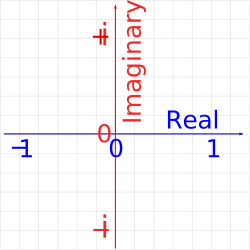
And we get the Complex Plane
A complex number can now be shown as a point:
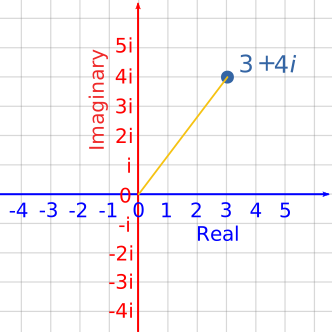
The complex number 3 + 4i
Properties
The letter z is often used for a complex number:
z = a + bi
- z is a Complex Number
- a and b are Real Numbers
- i is the unit imaginary number = √−1
we refer to the real part and imaginary part using Re and Im like this:
Re(z) = a
Im(z) = b
The conjugate (it changes the sign in the middle) of z is shown with a star:
z* = a − bi
We can also use angle and distance like this (called polar form):
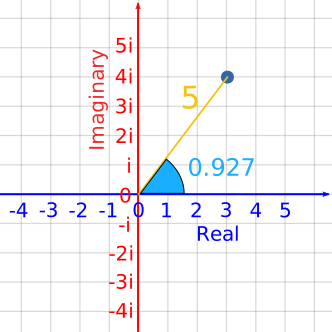
So the complex number 3 + 4i can also be shown as distance 5 and angle 0.927 radians. To convert from one form to the other use Cartesian to Polar conversion.
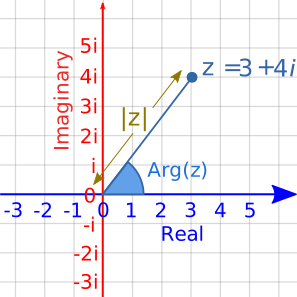
The magnitude of z is:
|z| = √(a2 + b2)
And the angle of z, also called Arg(z) is:
Arg(z) = tan-1(b/a)
(for a>0)
Example: z = 3 + 4i
- z is a Complex Number
- 3 and 4 are Real Numbers
- Re(z) = 3
- Im(z) = 4
- |z| = √(32 + 42) = 5
- Arg(z) = tan-1(4/3) = 0.927... radians
- z* = 3 − 4i
Adding
To add two complex numbers we add each part separately:
(a+bi) + (c+di) = (a+c) + (b+d)i
Example: add the complex numbers 3 + 2i and 1 + 7i
- add the real numbers, and
- add the imaginary numbers:
(3 + 2i) + (1 + 7i)
= 3 + 1 + (2 + 7)i
= 4 + 9i
Let's try another:
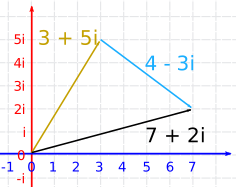
Example: add the complex numbers 3 + 5i and 4 − 3i
(3 + 5i) + (4 − 3i)
= 3 + 4 + (5 − 3)i
= 7 + 2i
On the complex plane it is:
Multiplying
To multiply complex numbers:
Each part of the first complex number gets multiplied by
each part of the second complex number
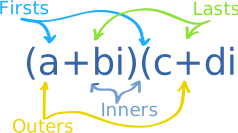
Just use "FOIL", which stands for "Firsts, Outers, Inners, Lasts" (see Binomial Multiplication for more details):
 |
|
|
(a+bi)(c+di) = ac + adi + bci + bdi2 |
|
Like this:
Example: (3 + 2i)(1 + 7i)
(because i2 = −1)
= −11 + 23iAnd this:
Example: (1 + i)2
(because i2 = −1)
= 0 + 2iBut There's a Quicker Way!
Use this rule:
(a+bi)(c+di) = (ac−bd) + (ad+bc)i
Example: (3 + 2i)(1 + 7i) = (3×1 − 2×7) + (3×7 + 2×1)i = −11 + 23i
Why Does That Rule Work?
It is just the "FOIL" method after a little work:
And there we have the (ac − bd) + (ad + bc)i pattern.
This rule is certainly faster, but if you forget it, just remember the FOIL method.
Let's try i2
Just for fun, let's use the method to calculate i2
Example: i2
We can write i with a real and imaginary part as 0 + i
And that agrees nicely with the definition that i2 = −1
So it all works wonderfully!
Learn more at Complex Number Multiplication.
Conjugates
We'll need to use conjugates in a minute!
A conjugate is where we change the sign in the middle like this:

A conjugate can be shown with a little star, or with a bar over it:
Example:
5 − 3i = 5 + 3i
Dividing
The conjugate is used to help complex division.
The trick is to multiply both top and bottom by the conjugate of the bottom.
Example: Do this Division:
2 + 3i4 − 5i
Multiply top and bottom by the conjugate of 4 − 5i :
2 + 3i4 − 5i×4 + 5i4 + 5i = 8 + 10i + 12i + 15i216 + 20i − 20i − 25i2
Now remember that i2 = −1, so:
= 8 + 10i + 12i − 1516 + 20i − 20i + 25
Add Like Terms (and notice how on the bottom 20i − 20i cancels out!):
= −7 + 22i41
Last we should put the answer back into a + bi form:
= −7 41 + 2241i
DONE!
Yes, there's a bit of calculation to do. But it can be done.
Multiplying By the Conjugate
There's a faster way though.
In the previous example, what happened on the bottom was interesting:
(4 − 5i)(4 + 5i) = 16 + 20i − 20i − 25i2
The middle terms (20i − 20i) cancel out:
(4 − 5i)(4 + 5i) = 16 − 25i2
Also i2 = −1 :
(4 − 5i)(4 + 5i) = 16 + 25
And 16 and 25 are (magically) squares of the 4 and 5:
(4 − 5i)(4 + 5i) = 42 + 52
Which is really quite a simple result. The general rule is:
(a + bi)(a − bi) = a2 + b2
That can save us time when we do division, like this:
Example: Let's try this again
2 + 3i4 − 5i
Multiply top and bottom by the conjugate of 4 − 5i :
2 + 3i4 − 5i × 4 + 5i4 + 5i = 8 + 10i + 12i + 15i216 + 25
= −7 + 22i41
And then back into a + bi form:
= −7 41 + 2241i
DONE!
Notation
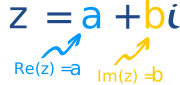
We often use z for a complex number. And Re() for the real part and Im() for the imaginary part, like this:
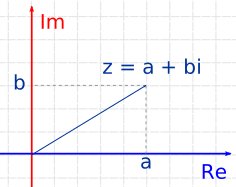
Which looks like this on the complex plane:
The Mandelbrot Set
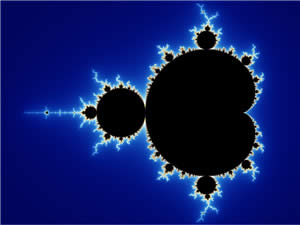 |
The beautiful Mandelbrot Set (pictured here) is based on Complex Numbers. It is a plot of what happens when we take the simple equation z2+c (both complex numbers) and feed the result back into z time and time again. The color shows how fast z2+c grows, and black means it stays within a certain range. |
|
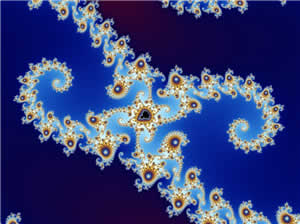
Here's an image made by zooming into the Mandelbrot set |
 |
| And here's the center of the previous one zoomed in even further: | 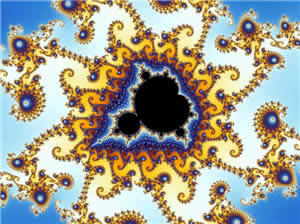 |