General Form of a Polynomial
A polynomial with one variable looks like this:
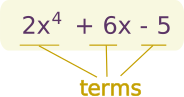 |
| example of a polynomial this one has 3 terms |
But how do we talk about general polynomials? Ones that may have lots of terms?
General Form
A general polynomial (of one variable) could have any number of terms:
Degree 2 (Quadratic) can have letters a,b,c:ax2 + bx + c
Degree 3 (Cubic) can have letters a,b,c,d:ax3 + bx2 + cx + d
......
Degree "n" has trouble with letters:axn + bxn-1 + ... + ?x + ?
The trouble is: we don't know what letters to end on!
So instead of "a, b, c, ..." we use the letter "a" with a little number or letter following it that says which term it belongs to:

"a-sub-n by x-to-the-n"
So for the general case, we use this style:

So now we have:
- an is the coefficient (the number we multiply by) for xn,
- an-1 is the coefficient for xn-1,
- ... etc, down to ...
- a1 is the coefficient for x (because x1 = x), and
- a0 is the constant term (because x0 = 1)
Example: 9x4 + 5x2 − x + 7
- a4 = 9
- a3 = 0 (there is no x3 term)
- a2 = 5
- a1 = −1
- a0 = 7
Note also:
- The Degree of the polynomial is n
- an is the coefficient of the highest term xn
- an is not equal to zero (otherwise no xn term)
- an is a Real Number
- n can be 0, 1, 2, and so on, but not infinity
1126, 4018, 9030, 9031, 9032, 9033, 9034, 9035, 1127, 4019